
North Carolina holds two dubious distinctions. It is ranked worst for workers for six years running (Oxfam 2025). And it scored best for business for three of the past four years (CNBD 2025).
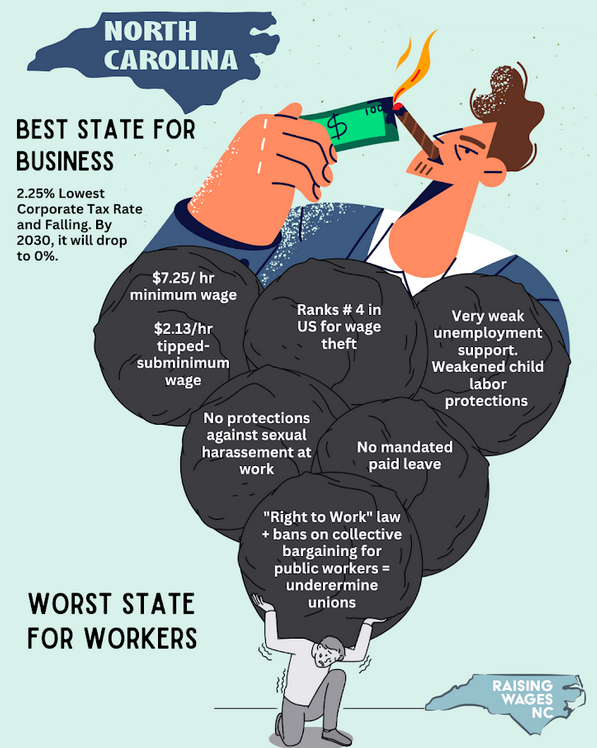
Together, these achievements tell the story of a deeply unfair economy that delivers outsized rewards to companies that enrich themselves through low pay, limited worker rights, and scant social obligations to NC people and communities.
Raising Wages NC Envisions Shared Prosperity
Raising Wages NC, a statewide coalition of base-building and advocacy groups that are building momentum and infrastructure for the long-term fight for better pay for workers, recently collaborated on an op-ed to call attention to this deeply divided economy. UFE serves as a co-convener and facilitator of Raising Wages NC. The piece has been published in The Wilson Times and The Johnstonian News. It describes the realities of a state where fully half of all workers earn less than a living wage, and how more and more workers are organizing for better pay, stronger rights, and greater obligations of employers to the well-being of communities.
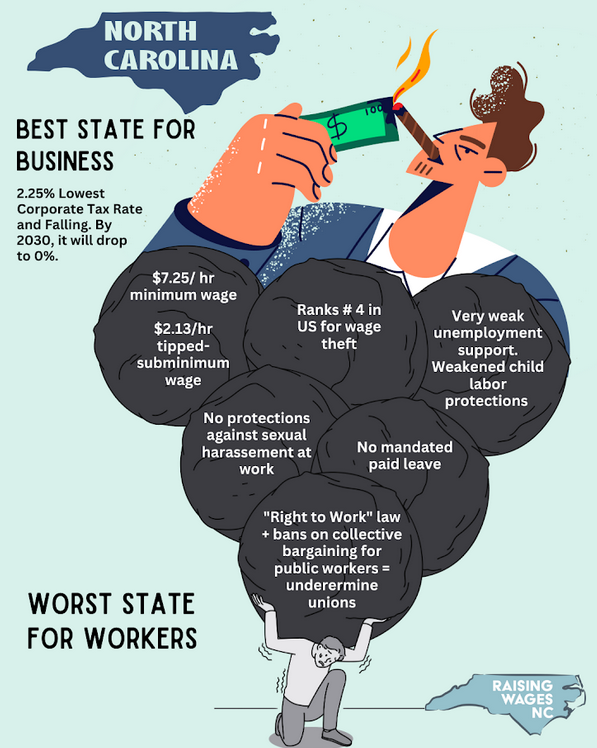
In NC's economy, workers shoulder the burdens necessary for corporate enrichment
The op-ed is printed in its entirety below.
CNBC recently announced that North Carolina is ranked as the top state for business for the third time in four years. We can all agree that our state’s workers provide talent and reliability that attract industry and entrepreneurship from across the nation.
But let’s be honest: North Carolina workers haven’t shared in the prosperity that businesses have enjoyed in a system tilted against working people. And we should be skeptical of celebrating a ranking that embeds an anti-labor definition of “business friendliness” and treats pro-business and pro-worker policy as mutually exclusive.
A closer look at CNBC’s report shows that a #1 ranking for business isn’t necessarily good news for working people. The report cites a “strong workforce” as a driving factor behind our state’s success, but that’s misleading to anyone who thinks the category refers to the health and well-being of the workforce.
Instead, “strong workforce” measures how useful working people are to businesses, while ignoring the insecurity, indignity, and exploitation many face on the job. Other rankings and realities that North Carolina and its workers contend with are widespread wage theft, where North Carolina ranks fourth worst in the nation, a $7.25/hr minimum wage that traps working families in poverty, a $2.13/hr tipped-subminimum wage — a relic of slavery that all but 16 states have increased or eliminated, a ban on collective bargaining for public employees, and one of the stingiest unemployment insurance systems in the nation.
Even worse, CNBC awards North Carolina high marks for “business friendliness,” a category that is also bad news for working families. That category underscores the misguided anti-labor framework of CNBC’s methodology, rewarding states for offering the “least resistance” to businesses, which really means stripping away labor protections and workers rights. In fact, the report incorporates OXFAM’s ‘Best and Worst States to Work in the U.S.’ report — which has ranked North Carolina dead last in the nation for five consecutive years on the basis of wages, protections, and union organizing rights — the latest OXFAM report having come out in late August, since the CNBC ranking.
It’s noteworthy that while CNBC celebrates North Carolina’s business climate, the report gives our state a C+ for ‘Cost of Living’ and C- for ‘Quality of Life,’ the two categories that tell us the most about the well-being of our people.
And the truth is grim. One in 3 of our residents is considered low-income, and half of workers earn less than $23 an hour — the statewide living wage for a family of 4. In a state where low wages are widespread and costs are rising, parents with one or more jobs are struggling to afford rent and breakfast for their children. Loved ones are going without care because their working caregivers lack paid leave. The situation is even more dire for immigrant and undocumented workers, who face fewer, if not zero, real protections in their workplace due to their immigration status. That’s the reality of life in the worst state for workers.
A strong economy should mean the people’s prosperity is served by the state’s businesses, and not the other way around. A strong workforce should mean workers earn a living wage, enjoy basic protections, have their victories celebrated, and see their interests championed by leaders who represent them in elected office. A business-friendly environment is one where employers can remove their “now hiring” signs, because workers can afford to stay, build lives, and thrive
That is the economy worth celebrating. It’s not yet the economy we have, but it’s one that North Carolinians are fighting for. As our state just celebrated Labor Day, workers and advocates are asking the question: Is North Carolina the top state for business in spite of being the worst for workers — or because of it?
Sam Stites works at Just Economics of WNC and is a Transylvania County-based labor advocate and member of the Raising Wages North Carolina coalition.

Envisioning a future where we can all thrive with living wages, strong rights, and fully funded public services
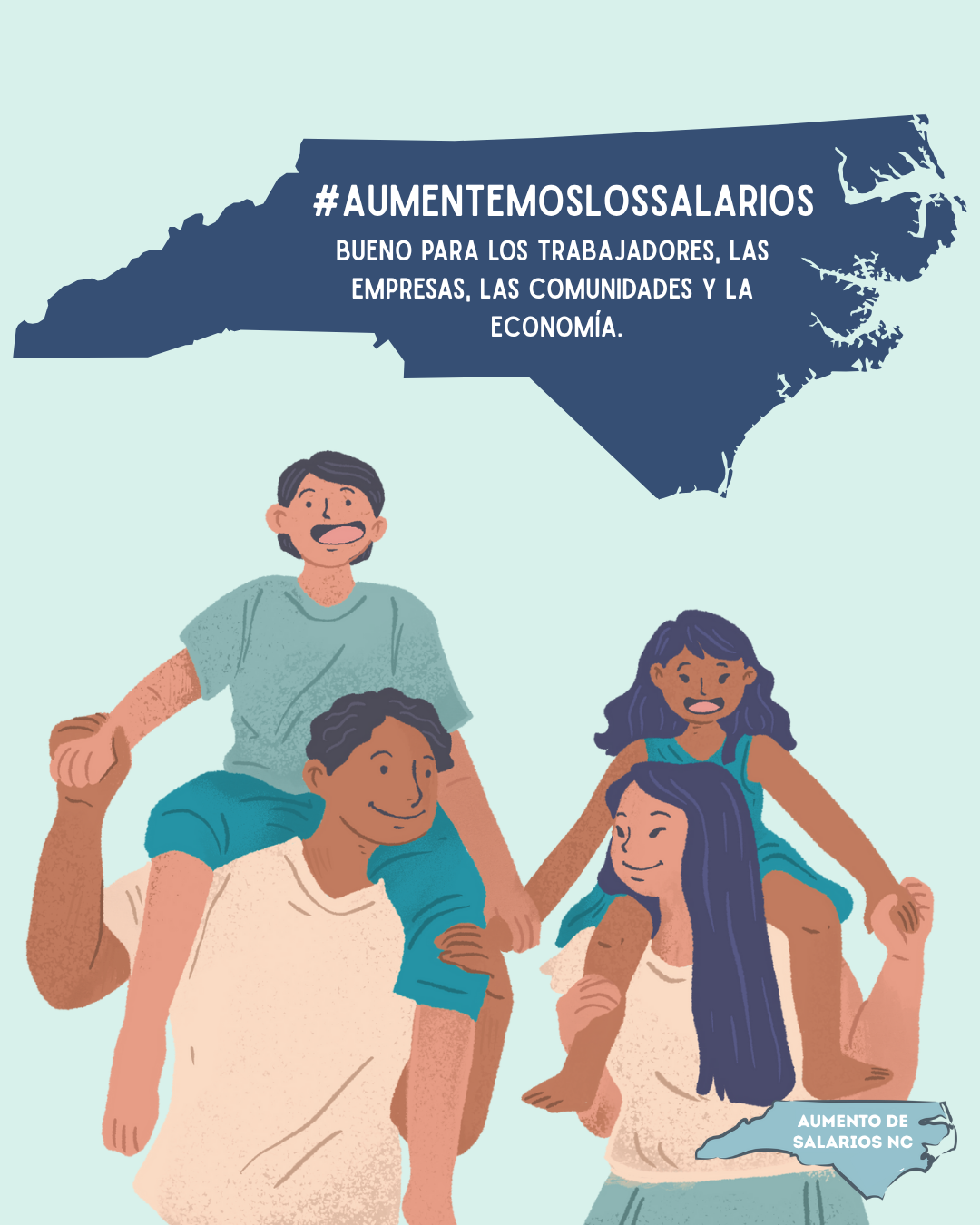
To learn more about Raising Wages NC and join in their efforts, visit raisingwagesnc.org.
CNBC, 2025. “North Carolina is America’s Top State for Business in 2025, led by a strong workforce and economy,” July 10. Available at: https://www.commerce.nc.gov/news/press-releases/2025/07/10/cnbc-names-north-carolina-1-state-business
Oxfam, 2025. “Best States to Work in the US 2025.” Available at: https://www.oxfamamerica.org/explore/research-publications/best-states-to-work-in-the-us-2025/
Showing 1 reaction
Sign in with