
New Website! • Obama A Psychic? • We Need Your Support!
It's the week before tax day, and there's been a storm of activity at UFE.
We launched a shiny new website—which you may have already gathered—with interactive features like user comments and social media buttons for ease of sharing. When you're done here, be sure to click around, let us know your thoughts and keep your online networks posted on what articles you liked (or didn't) on our new site.
And, we jump-started our 2011 Responsible Wealth Tax Fairness Pledge. This year's slogan: 'TAX WEALTH LIKE WORK!'
Why? Because money made from money should be taxed at the same rates as hard-earned wages. Taxing capital gains and dividends like work income would largely impact the wealthiest households, raising $84 billion to help keep schools, health care and other community services going.
It's easy to get involved. Your pledged support enables groups like UFE and our grassroots Tax Fairness Organizing Collaborative members to do the work it takes to achieve progressive tax victories.
During his April 13 budget speech, President Obama showed off his political clairvoyance:
[W]ithout even looking at a poll, my finely honed political instincts tell me that almost nobody believes they should be paying higher taxes.
My first thought was that the President was having a psychic off day. Then it occurred to me that "almost nobody" could just be a passive way of calling out the very few, but very rich, corporatist elites—like the Koch Brothers—who throw their political weight around in the name of making more money. A 2010 Quinnipiac poll showed that of those earning more than $250,000 annually, 64 percent supported higher taxes on themselves, and 67 percent supported higher taxes on those with $1 million-plus incomes.
Do you think - raising income taxes on households making more than $250,000 should or should not be a main part of any government approach to the deficit?

Do you think - raising income taxes on households making more than 1 million dollars should or should not be a main part of any government approach to the deficit?

It's truly frightening to imagine the kind of power we're up against; when the overwhelming majority of voters—including many wealthy ones (like Responsible Wealth members)—agree that we should raise taxes on the wealthy for the greater good, but we still have to fight tooth and nail to make it happen.
And fight we will, because our families and communities are at stake. We hope you'll join us in the fight for tax fairness by taking the Tax Fairness Pledge today.
While you're there, check out testimonials from other taxpayers at different income levels. We're still collecting testimonials, so if you're interested in being a part of this project, send an email to UFE's Communications Team at [email protected], and they'll send you a brief guide.
INTERVIEW: Do Tax Breaks for the Rich Help the Economy?
Responsible Wealth Director Mike Lapham joined Julie Dougherty and Ken Morgan, hosts of Money Radio's "Business for Breakfast" (Phoenix, AZ), to explain the failure of tax breaks for the wealthy, and to urge Arizonans to join RW's "Tax Wealth Like Work" campaign to tax investment income like wages.
Take a Stand for Tax Fairness!
 Tax Day is on Monday, April 18th! After you file your paperwork, take a stand for tax fairness! Amid the slew of recent and proposed budget cuts to programs that matter deeply to working and middle class families, we must reinforce the point that more revenue can prevent program cuts and reduce the deficit.
Below is an 'activist's digest' of sorts which includes many notable events and resources related to Tax Day 2011!
TAKE ACTION! Demonstrate, Call Congress, or Sign Petitions
-
United for a Fair Economy and Responsible Wealth: Tax Work Like Wealth Campaign
We are calling on Congress to tax capital gains and dividends at the same rate as income from work instead of the current rate of 15 percent. Sign on to our compaign, calculate your tax cut, donate your tax savings, or just watch the taxpayer testimonials. (You can even submit your own movie!) UFE is also asking people to call Congress to support Rep. Jan Schakowsky's Fairness in Taxation Act, HR 1124, which taxes millionaires' capital gains at the same rate as income from work, and adds higher income tax rates for millionaires and billionaires.
-
US Uncut Demonstrations: April 15-18th
US Uncut protests corporations like Verizon and FedEx which have dodged all or most of their U.S. income taxes at a time when lawmakers are cutting basic public services to address federal and state budget gaps. Many of these demonstrations will have a creative or fun aspect. Find US Uncut events near you.
-
U.S. PIRG Events at Post Offices: April 15th & 18th
The U.S. Public Interest Research Group acitivities will be holding events outside of Post Offices on April 15 and April 18 in at least a dozen states. These events will target people whose minds are very much on taxes as they mail off their federal income tax returns. US PIRG will try to get Congress to address tax dodging corporations with report releases and post-carding.
-
MoveOn Events: April 18th
"On Tax Day, April 18, as millions of Americans patriotically pay their taxes, we will call on corporations and millionaires to pay their fair share. At hundreds of events from coast to coast, we’ll present tax bills to corporate tax dodgers for the billions of dollars their legions of lobbyists helped them avoid. We’ll organize a peaceful, dignified, and powerful day of action to call on corporations to pay their fair share. And we’ll demand that our elected leaders make them pay." (Their events appear to include the US Uncut events.) Find MoveOn events near you.
TAX DAY RESOURCES
-
DEMOS
Demos' Taxes Matter week provides a fresh outlook on how we think about taxes. Check out "Reclaiming Public Discourse on Taxes," which includes talking points and an informative webinar.
- Who can resist a great infographic? Have a look at Tax Breaks vs. Budget Cuts by the Center for American Progress. Or this comparison of budget cuts vs. tax cuts for the wealthy by the Economic Policy Institute.
- A few other organizations with excellent resources: Citizens for Tax Justice, the Center for Budget and Policy Priorities, and the Tax Policy Center.
Please share this information widely with family and friends, send it to groups you are part of, and promote it via social media.
Pushing Obama from the Left
Mike Lillis writes in The Hill about the challenge President Obama faces as he attempts to play to the center while appeasing ever-rowdier and more extremist Republicans. As he gets ready to unveil his deficit reduction proposal, he risks alienating his base, who if uninspired, may not contribute to his re-election campaign and even stay home in November 2012.
While early reports indicate that Obama may include some good things in his proposal, such as ending some of the tax breaks for the wealthy and reducing military spending as part of his deficit reduction plan, other questions still remain. How strong will those proposals be? And will he include deep Medicare and Medicaid cuts?
...As Obama prepares Wednesday to outline his deficit reduction strategy, liberals worry he’ll embrace Medicare and Medicaid cuts as an olive branch to Republicans in advance of larger fights over the nation’s debt...
..Liberal lawmakers already were irked with Obama’s decision to support upper-income tax cuts he campaigned against and to launch military operations in the Middle East without congressional approval.
Rep. Peter DeFazio (D-Ore.) this week said Obama should start acting like a Democrat, while two left-wing grassroots groups warned their members could withhold funds from the president’s reelection campaign... The criticisms highlight the problem facing Obama, who is trying to lead from the center without alienating his political base. The White House strategy could help the president with independents, but risks leaving liberals at home in the fall of 2012.
In addition to harsh criticisms coming from the Congressional Black Caucus (CBC), the Congressional Progressive Caucus (CPC) released it's own budget, "The People's Budget," to place a flag in the ground to the Left of Obama's centrist position.
The People's Budget includes smart tax proposals: enacting a progressive estate tax, closing corporate tax loopholes, enacting a new set of income tax rates for incomes over a million dollars, and taxing capital gains the same as ordinary income. The plan also includes rolling back military spending and focusing limited federal dollars on job creation programs here at home and upgrading our nation's aging infrastructure.
In addition to the new and stronger push-back coming from progressive in Congress, including the CBC and the CPC, outside organizing is underway to hold Obama accountable to his political base before it's too late.
But the real question is, how hard will progressives push Obama from the Left? Are we willing to push as hard from the Left on Obama as the Tea Party and freshman Republicans are pushing on Rep. Boehner from the Right? In the end, as FDR said after his election and President Obama himself paraphrased, we must "make [him] do it."
It's Time to Tax Wealth Like Work
 When it comes to taxes, not all income is created—or taxed—equal. Despite the time-honored value of rewarding hard work, our tax code gives preferential treatment to income derived from pre-existing wealth instead of income earned from work.
Take the Tax Fairness Pledge now!
Here are other things you can do:
- Learn more about the special tax breaks for investment income.
- Use the interactive tax calculator, watch videos, and take the Tax Fairness Pledge.
- Read about proposals to end the tax break for capital gains and dividends.
- Read press release announcing Tax Wealth Like Work campaign.
- Follow coverage of our 2011 Tax Wealth Like Work campaign.
- See coverage from last year's Tax Fairness Pledge.
INTERVIEW: Income Inequality & Social Justice in America
In the US, the gap is widening fast between fewer and fewer rich people and everyone else. Do Americans care?
Columbia professor and Responsible Wealth member Eric Schoenberg joined Warren Olney, host of KCRW Los Angeles' "To the Point," for a conversation about why wealthy and upper-income members of Responsible Wealth support raising taxes on themselves.
Other guests include:
- Mark Bittman: New York Times
- Michael Norton: Harvard Business School
- Jason Rink: Foundation for a Free Society
- Tom Donlan: Barron's National Business and Financial Weekly
Download the interview (forward to 18:44 to hear from RW member Eric Schoenberg)
Proposals to Tax Wealth Like Work
 Our current tax system rewards wealth over work by taxing capital gains and dividend income at a much lower rate than salaries and wages. UFE is calling for the restoration of the tax rates on capital gains and dividends to the same rate applied to income earned from work. Various proposals have been put forth to move in that direction.
1. President Obama's proposal to roll back the Bush income tax cuts for the wealthiest households. His proposal would restore the top income tax rates and the capital gains rate to their pre-Bush levels for those earning over $250,000. If the Obama plan were law, the top rate on regular income would be returned to 39.6 percent, while the top rates for dividends and capital gains would be 20 percent. This is a step in the right direction, but it only partially restores capital gains and dividends to the same tax rate as wages. First, capital gains and dividend income below the $250,000 threshold would still be taxed at a rate much lower than income earned from work. For income over that threshold, capital gains and dividends would still be taxed at nearly half the rate on income from work (20 percent vs. 39.6 percent).
2. Rep. Jan Schakowsky's Fairness in Taxation Act (H.R. 1124). This bill would create a new set of income tax brackets of 45% through 49 percent for income in excess of $1 million. The top rate of 49 percent would apply only to the very exclusive group of Americans with income over $1 billion a year. Capital gains and dividend income under the $1 million threshold would still benefit from the preferential rate, but similar income over that threshold would be taxed at full parity with wage and salary income. The Fairness in Taxation Act, including both the income tax rates and the capital gains and dividend rates, would raise $78 billion.
3. The Congressional Progressive Caucus' “People’s Budget.” This plan includes, among other provisions, taxing capital gains and dividends as ordinary income. The bipartisan Deficit Commission included the exact same measure in its December 2010 recommendations.
Learn more:
- Why we should tax wealth like we tax work
- Take action to support tax solutions for the 99%.
- Op-ed by UFE's Mazher Ali in support of the Fairness in Taxation Act
- Press release announcing support of the Fairness in Taxation Act
- Outline of House Progressive Caucus’ “People’s Budget”
VIDEO: What is a Loophole?
What is a loophole? Can you hold one? And if you remove them from state budgets, what could we we actually pay for? Here's a radically moderate perspective on loopholes via video, courtesy of the Washington Bus, an organization that empowers young people through hands-on democracy.
Fair Taxation Means More Brackets Up Top
Originally published by OtherWords.
So many governors are hammering their budgets with a “we’re broke” message these days that it’s amazing our country hasn’t shattered into a thousand separate islands. More and more, however, rational voices are correctly asserting that we’re not broke.
The problem isn’t that the United States is out of money. It’s that a tiny sliver of households are under-taxed. The richest 10 percent of Americans own almost three-fourths of the country’s total wealth. Astoundingly, the most affluent 1 percent of Americans own more than one-third of our total wealth.
 Thankfully, the message that our country isn't broke is making its way closer to the center of the tax and deficit debates. It can’t get there soon enough.
Many Republican lawmakers, along with governors like Wisconsin's Scott Walker and Ohio's John Kasich, bizarrely think that they can erase deficits with tens of billions of dollars in budget cuts and tax breaks for corporations and wealthy people who don’t need them. They’re ignoring the greatest economic returns available, which are provided by public investments, federal aid to states, and even unemployment benefits. Instead of helping save the middle class, they're propelling us toward a busted, plutocratic disaster.
The GOP's deficit obsession isn't just misguided. It turns a blind eye on the struggles of low- and middle-income Americans. In contrast, Rep. Jan Schakowsky’s sensible Fairness in Taxation Act would raise taxes on millionaires and billionaires, which better serves the American majority.
Currently, families earning $374,000 pay the exact same federal income tax rates as families with multi-million-dollar incomes, or even the handful who earn a billion bucks every year, such as the heirs of Walmart's founder. The lifestyles of the ultra-wealthy wouldn’t change in the least if they had to pay moderately higher income taxes. And it would boost our national economy.
The Fairness in Taxation Act calls for establishing five new tax brackets for incomes between $1 million and $1 billion, with rates ranging from 45 percent to 49 percent.
The Illinois Democrat's bill would also address an absurd aspect of our tax system, which wrongly favors wealth over work. Today, money earned through working nine-to-five or the graveyard shift is taxed at a higher rate than money obtained through windfalls. Capital gains, dividends, and other investment income derived from pre-existing wealth shouldn't be taxed at rates lower than income earned through work.
Three-quarters of all stocks and mutual funds owned by U.S. taxpayers belong to the richest 10 percent of American households. Therefore, some of the most affluent Americans actually pay lower effective tax rates than many middle-class Americans.
Take, for example, a weasel like Lloyd Blankfein, CEO of Goldman Sachs. He raked in just over $13 million in 2010 (excluding his bonus of some $12 million worth of shares in his company). Of that $13 million, only his base salary of $600,000 will be taxed according to the federal income tax rates. The remaining $12.4 million will be taxed at a top rate of 15 percent. Unfortunately, Blankfein is just one example of the kind of gross inequity that exists in the current tax system.
A century ago, tax policies adopted during President Teddy Roosevelt's administration were guided by sound principles that stand in direct contrast to those of today’s Republicans.
“No man should receive a dollar unless that dollar has been fairly earned,” explained Roosevelt in a 1910 speech. “Every dollar received should represent a dollar's worth of service rendered--not gambling in stocks…I believe in a graduated income tax on big fortunes."
The Fairness in Taxation Act takes aim at the same inequities Teddy Roosevelt--a Republican--identified long ago. If it were enacted this year, it would generate $78 billion that could fund jobs and social programs that Americans need now more than ever.
Repeat after me: we're not broke. It’s time to mandate that the wealthiest members of our communities share in the sacrifice of the economic recovery and pay their fair share. The Fairness in Taxation Act offers a clear path in that direction.
Corporate Responsibility
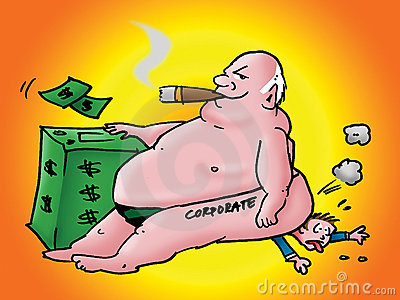 When corporations acquire too much power and influence, it threatens the air we breathe, the water we drink, and the health of our democracy. Amid the rising power and political muscle of major corporations in recent decades, the need to counter greedy and harmful corporate practices has grown exponentially.
The Rise of CEO Pay
Executives of corporations receive financial compensation often as a mixture of salary, bonuses, shares of the company stock, etc. Over the past 60 years, executive pay has increased astronomically. In fact, CEO pay in 2009 had more than doubled the CEO pay average for the decade of the 1990s, more than quadrupled the CEO pay average for the 1980s, and ran approximately eight times the CEO average for all the decades of the mid-20th century. (link: Institute for Policy Studies)
The contrast between executive pay and average worker pay is stunning. In 2009, CEOs of major US companies averaged 263 times the pay of typical American workers. Back in the 1970s, CEOs made 30 times average worker pay. To make matters even more galling, taxpayers subsidize these outlandish executive salaries to the tune of more than $20 billion a year through tax and accounting loopholes.
In 2010, Congress passed major health care and financial reform bills, both of which contained small executive compensation related policies. The health care reform bill capped the tax deductibility of health insurance executive pay, and the financial reform bill required that all firms report CEO-worker pay ratios. Much more needs to be done and there’s no shortage of good ideas to reign in outsized executive compensation.
Shareholder Activism
One of the key tools for speaking out against rising CEO pay and harmful corporate practices is shareholder activism. In addition to legislation, it is one of the most powerful tools for advancing corporate reforms.
Corporations are owned by shareholders, who can be individuals or institutions (such as mutual funds). If certain legal and regulatory requirements are met, shareholders are permitted to offer resolutions that get voted on at a corporation’s annual meeting. Shareholder resolution issues can be financial – e.g., executive compensation, predatory lending practices – or non-financial – e.g., board diversity, divestment from particular countries.
Shareholder resolutions are only advisory, meaning that even if a resolution passes, it is not required to be implemented by the corporation. However, resolutions often put unwanted public attention and pressure on corporate leaders and, thus, are used as leverage to win shareholder demands. Read more about shareholder activism here.
Fairness in Taxation Act Arrives!
 Rep. Jan Schakowsky (D-IL) has introduced a bill that would ensure millionaires and billionaires contribute their fair share toward rebuilding and stabilizing our economy. Now, we need your support to move the bill forward. Please call your Representative and urge him/her to support the Fairness in Taxation Act! (Click here to find your Rep's contact info.)
Income inequality in the U.S. has reached levels not seen since the Great Depression. The policies that made that possible have also created unprecedented disparities of wealth. Today, the top 10 percent of households owns three-fourths of the country's total wealth, and the top one percent alone owns 34 percent!
The Fairness in Taxation Act would generate significant revenue to fund vital public services and infrastructure, while also reducing economic inequality.
Currently, the top tax bracket begins with incomes of $373,000 or more. In essence, households with incomes of several hundred thousand dollars are paying the same rates as those with multi-million or multi-billion dollar incomes.
The Fairness in Taxation Act would add new tax brackets for income starting at $1 million and ends with a $1 billion bracket. The new brackets would be:
- $1 - $10 million: 45%
- $10 - $20 million: 46%
- $20 - $100 million: 47%
- $100 million - $1 billion: 48%
- $1 billion and over: 49%
The bill would also tax capital gains and dividend income as ordinary income for those taxpayers with income over $1 million. If enacted in 2011, the Fairness in Taxation Act would raise more than $78 billion.
This bill makes perfect sense. It's a fair and sensible solution to our budget hardships, as it affects only those who can contribute more toward the greater good of our country without sacrificing their livelihoods. That's precisely why it has garnered the support of many wealthy taxpayers, including members of UFE's Responsible Wealth project.
Here's what some high-wealth supporters of the bill had to say:
I think very wealthy people like me should pay substantially higher taxes, since we have done exceedingly well in the last few decades. Our taxpayer-funded government contributed to my success.– Katharine Myers, Responsible Wealth member, in a March 16, 2011 press conference with Rep. Schakowsky et al.I strongly support the Fairness in Taxation Act...While I certainly wish to pass on to my children some of the wealth that I have been fortunate to accumulate, I also want my children to live in a country which avoids the political polarization that may develop as the wealth gap increases.– James E. Mann, Co-owner of New Hampshire Business Development Corp. & Partner in MerchantBanc[M]y husband and I are huge beneficiaries of government support. Every step of our careers was made possible with taxpayer dollars. We strongly feel the debt we owe our society... [R]aising our taxes would not affect our standard of living...I heartily support Rep. Jan Schakowsky’s Fairness in Taxation Act.– Dr. Alice Chenault, Responsible Wealth memberI support the Fairness in Taxation Act...because rich people can afford to pay higher taxes. About 90 percent of my income comes from investments, which currently are taxed at the lower capital gains or dividend rate of 15 percent. I would pay much higher taxes under this bill. That's fine with me, because our government helped contribute to my wealth by protecting the patents I used to start a company.– Steve Kirsch, CEO of Propel Software Corp.
This bill has been introduced at a time when conservative officials across the country are calling for drastic cuts to education, health care and myriad other programs that will further affect our social and economic integrity.
American workers have suffered enough. We need the wealthiest members of our communities to share in the sacrifice of the economic recovery. The Fairness in Taxation Act offers a superior alternative to more painful budget cuts.
It's imperative that we speak out, together and as loudly as possible, in support of this bill and other progressive tax initiatives. With your support and the support of others like you, tax justice will always stand a fighting chance.
Unions and Democracy
Unions do far more than negotiate benefits for its own workers. Unions have fought to strengthen public policies that benefit all Americans, both unionized and non-unionized. And as corporate power and influence has skyrocketed in recent years, unions have provided a powerful mechanism for voter turnout that keeps our democracy strong.
Historically, unions have fought to strengthen public policies that benefit all Americans, both unionized and non-unionized. Unions have fought to strengthen minimum wage laws, worker safety protections, and public safety nets. We have unions to thank for the two-day weekend and the 40-hour workweek. More recently, unions have fought to strengthen minimum wage laws, worker safety protections, and public safety nets.
Decline of Union Power
Since the 1980s, the presence and power of organized labor in the U.S. has sharply declined. Today, union members account for roughly 12 percent of the workforce, down from 20 percent in 1983. In the public sector, the unionization rate is significantly higher at 36 percent. Over half of all unionized workers today are public sector employees.
Unions Keep Democracy Strong
As the number of unionized workers in the U.S. decreased, the number of corporate lobbyists has skyrocketed. Beginning in the 1970s, well-heeled corporations began to organize and work to undo these earlier labor victories. In 1968, only 100 corporations had public affairs offices in Washington. By 1982, the number of registered lobbyists in D.C. reached 2,500. That’s a whopping 2,400 percent increase in just under 30 years.
This decline in union power over the past 30 years has hurt all Americans. Historically, unions have helped to provide a powerful mechanism for voter turnout that keeps our democracy strong. Unions represent one of the few organized forces that provide a counterbalance to the influence of corporate money and power in our democracy.
Class, Race & the Attacks on Public Employees
Originally posted on Classism Exposed, March 11, 2011
The Wisconsin uprising has become as loud a wake-up call as there has ever been that working America is under attack. Moves by Governor Scott Walker and the Republican majority to steal away the collective bargaining rights of public sector workers – as a false premise for the state’s budgetary hardships – has triggered a national uproar by labor rights supporters.
In spite of all the good organized labor has brought to all American workers – union and non-union alike – union membership in the U.S. has endured constant erosion by the corporate sledge over the past several decades.

The result has been an economic gulf, separating the rich from everyone else.

The top 10 percent of U.S. households own nearly three-fourths of the country’s total wealth; 34 percent is held by the top one percent alone. Some among this very wealthy elite have a profit-lust so insatiable that it’s causing the American middle class to fade from existence, as income stagnates and the unemployment crisis continues.
If Governor Walker succeeds in his anti-union crusade, we could face a system-wide shift that would further obscure the voices of average workers. Attacks on collective bargaining are, in essence, attacks on democracy. To dilute the power of unions is to actively support plutocracy, or rule by the wealthy.
Who Stands to Lose the Most?
What too many of us don’t know is who has the most to lose from attacks on organized labor. Unfortunately, the answer shouldn’t come as a surprise.
When it comes to organized labor, the public sector has served as a far more reliable foothold than the private sector. The more stringent equal opportunity and civil service protections of the public sector offer more agreeable circumstances for historically disenfranchised workers than private sector jobs. For example, the public sector has offered more opportunities for women and workers of color to achieve income parity with white men.

Initiatives such as that of Wisconsin’s Governor to break down public unions will be especially harmful to those who already face a constant battle against workplace discrimination.
A recent report by United for a Fair Economy emphasizes the vital role of the public sector in providing opportunities to people of color, who are burdened not only with the residual effects of past injustices, but also contemporary barriers to upward economic mobility. Today, Black workers are significantly more likely than the overall workforce to hold government positions. Because of that reality, across-the-board cuts to the federal, state and even local budgets would have particularly ruinous effects on Black workers.

If we’re ever to move beyond a jobless recovery, and meaningfully address the disgraceful racial inequality that tars our supposed “civil” society, it is imperative that we preserve the public sector by funding a jobs program that invests in our people and in the longer-term stability of our economy.
Where’s the Money?
The phrase “we’re broke” as rationale for bone-deep budget cuts isn’t just tired, it’s wrong. We’re not broke. We’re still a very wealthy country. The problem, as earlier mentioned, is that too much of this country’s wealth is concentrated in too few pockets. Robert Reich asserted:
You can’t fight something with nothing. But as long as Democrats refuse to talk about the almost unprecedented buildup of income, wealth, and power at the top – and the refusal of the super-rich to pay their fair share of the nation’s bills – Republicans will convince people it’s all about government and unions.
And, not to make a total scapegoat of the GOP, Reich points out the Dems’ misguided politicking:
The Republican message is bloated government is responsible for the lousy economy that most people continue to experience. Cut the bloat and jobs and wages will return.
Nothing could be further from the truth, but for some reason Obama and the Democrats aren’t responding with the truth. Their response is: We agree but you’re going too far. Government employees should give up some more wages and benefits but don’t take away their bargaining rights. Private-sector unionized workers should make more concessions but don’t bust the unions. Non-defense discretionary spending should be cut but don’t cut so much.
The money for a jobs program and other recovery measures exist, but we’re not tapping the most abundant sources.
Let’s demand that corporations stop dashing off-shore to avoid paying their tax tabs.
Let’s tax the high-risk, casino-like investing on Wall Street that so heavily contributed to the financial meltdown.
Let’s restore progressiveness to the personal tax system by raising taxes on the wealthy, who have reaped the most from our economy and are most able to contribute more without sacrificing their livelihoods.
We can raise the top-tier federal income tax rates to their pre-Bush levels (at the very least), and add new brackets for those with remarkably high incomes. We can strengthen the estate tax – a means to prevent the creation of American dynasties and reduce wealth inequality – well beyond its current form. We can bring an end to preferential treatment of investment income – like capital gains and dividends – by taxing it the same as earned income.
And, let’s wean the Pentagon – which now accounts for 58 percent of the discretionary federal budget – off of the taxpayers’ proverbial teat by cutting unnecessary defense spending.
The revenue generated would be more wisely applied to domestic investments. But, investments should be made using a targeted approach that would address chasms of race and class in the U.S.

We’ll first have to establish a shared agreement about the type of society in which we want to live. Will it be one that encourages greed and inequality, or one that provides essential services and opportunities to all of us? Will it be one that provides access to only the financially enriched, or one that’s truly democratic? Will it continue to pit us against one another, or will it inspire togetherness and community?
And, while the historical intersections of the civil rights and labor movements haven’t always been flattering, it would be counterproductive to target unions for a legacy of discrimination that belongs to the nation as a whole. We should embrace the real hope that the two movements can find shared purpose, and move forward as a more diverse, inclusive and, most importantly, unified movement.
Ironically, It may well be Governor Walker’s outrageous attacks on public employees that ignites the very movement he seeks to destroy, and brings the U.S. toward a more just and egalitarian society.
Estate Tax

ESTATE TAX
A strong federal estate tax is a crucial to achieving greater economic and racial equality. The estate tax reduces concentrated wealth by ensuring that a portion of America's greatest fortunes are used to generate needed revenue to fund vital services, instead of being simply passed from generation to generation in predominantly white families.
FAQS
What is the estate tax?
The estate tax is a tax on the transfer of assets at death. When someone dies, his or her assets (the "estate") are distributed to heirs. If the total value of the estate is larger than the tax-exempt amount (currently $5.25 million for individuals and $10.5 million for couples), an estate tax is imposed on everything above the exemption before the remaining assets are distributed. Any amount of an estate given to a spouse or charity is tax exempt.
Who pays the estate tax?
The estate tax is reserved only for society's wealthiest elite. In 2013, just 0.14% of Americans (less than 2 out of every 1,000 people who die) are expected to owe any estate tax.
How much does the estate tax raise every year?
It's estimated the estate tax will generate about $200 billion in the next 10 years under current law.
What about farms and small businesses?
It's estimated that only 20 small businesses and farm estates nationwide will owe any estate tax in 2013. The Tax Policy Center estimates that these 20 estates will owe only 4.9% of their value in tax, on average. Repeal of the estate tax or exempting farms completely will only encourage further concentration of farm ownership, which reduces competition. An unlimited exemption for farm assets could create a giant loophole from the estate tax because wealthy individuals who expect to owe estate tax could use much or all of their wealth to buy farms before they die.
What makes for a good estate tax?
UFE's Estate Tax Campaign is calling on Congress to stop enriching the inheritors of wealthy millionaires and billionaires by reinstating a robust estate tax. A strong estate tax should raise significant revenue to reduce the deficit and fund vital services. It should only be paid by the top 1% of estates, raising more money from the wealthiest estates through a graduated rate structure. Check out our 2012 Responsible Estate Tax Proposal for more specifics.
Shifting Power: From Citizens United to Wisconsin
By Brian Miller | Originally published on CommonDreams.org, March 1, 2011
 Let’s be clear: Governor Scott Walker’s proposed cuts are not about balancing the state budget. It’s a power play aimed at cutting the heart out of what remains of the once vibrant labor movement. A war waged against unionized workers ultimately harms all workers, and the overt strategy to squelch collective bargaining exposes the deep resentment that monied interests hold towards worker rights everywhere.
The public sector unions in Wisconsin have already agreed to make sacrifices, including significant wage cuts and increased contributions to the pension fund. But these economic concessions are not enough for Governor Walker. That’s because his true goal is to permanently cripple the unions by defunding their organizational base and stripping away their right to collective bargaining.
Sadly, Wisconsin is just one of many front lines in this fight. In the wake of the November elections, anti-union measures are on the move in Ohio, Indiana, and elsewhere.
To understand the true significance of this assault on unions, one must remember that unions do far more than negotiate benefits for its own workers. Unions have fought to strengthen public policies that benefit all Americans, both unionized and non-unionized. We have unions to thank for the weekend and the 40-hour workweek. More recently, unions fought to strengthen minimum wage laws, worker safety protections, and public safety nets. And unions, much to the dismay of corporate power brokers, help provide a powerful mechanism for voter turnout that keeps our democracy strong.
Unions have long understood that “speaking truth to power” is not enough. It takes a strong, organized movement to affect real change in our society. That has become especially important in the face of rising corporate power and, more recently, the Supreme Court’s Citizens United ruling. Today, unions represent one of the few organized forces providing a counterbalance to the role of corporate money and power in our democracy. As the fight to limit corporate power through campaign finance reform and other such policies heats up, unions will undoubtedly play a crucial role.
From the 1940s through the mid-1970s, Americans saw an unprecedented period of economic growth, and more importantly, a period when income growth was shared proportionally across all major income groups. This was not an accident or a force of nature. It was the result of a deliberate set of public policies—including a highly progressive tax system, strong worker protections, and large-scale public investments in our shared infrastructure to name a few. But these laws didn’t just magically appear. They were created in part through the political organizing of strong, well-organized unions at a time when one out of three American workers were unionized.
Unions have long understood that “speaking truth to power” is not enough. It takes a strong, organized movement to affect real change in our society.
Beginning in the 1970s, well-heeled corporations began to organize and work to undo these earlier labor victories. In their new book “Winner-Take-All Politics,” Pierson and Hacker document this dramatic power shift. In 1968, only 100 corporations had public affairs offices in Washington. That grew to 500 by 1978. Only 175 firms had registered lobbyist in 1971. That grew to 2,500 by 1982. Mirroring this rise of corporate power was the realignment and dramatic growth of the Chamber and the National Federation of Independent Businesses as a powerful political force.
As corporate influence was on the rise, the once powerful labor unions that helped grow America’s strong middle class were under attack. In some cases, this was a frontal assault as powerful forces worked to undo union victories. In other cases, it was a dodge as corporations moved their operations to anti-union states, cutting the political legs out from under the unions.
As this fierce class war has waged on for the past 30 years, hard-working Americans have consistently been on the losing end. Many progressives point to Reagan as the impetus for this power shift, but Reagan was simply riding a tidal wave of corporate power that was laid in the decade before he took office. To the victor go the spoils indeed. Since this great power shift has taken place, we’ve seen tax cuts for the wealthy, deregulation, and the gutting of the public sector with profound implications for our society. Income inequality is now at its highest level since 1928, just before the Great Depression.
After nearly four decades of attack, only about 12 percent of American workers are now unionized. In the public sector however, the unionization rate remains at 36 percent. In fact, over half of all unionized workers are public sector employees today. This brings us full circle back to Wisconsin. As corporate influence continues to grow, Governor Walker is seeking to limit the power of working people by removing one of the most powerful tools in our cache: unions and their organizing power. If he succeeds, it will be deeply troubling for the health of our democracy.
If we as a nation are serious about renewing America’s commitment to a strong and vibrant middle class, we must look to reform the political landscape that created the winner-take-all economy. As the nation’s eyes remain on Wisconsin, it is in each or our interests—unionized and non-unionized, private sector and public sector workers—to stand in solidarity with our fellow Americans on the front lines in Wisconsin. The health of our democracy depends on it.
Visit CommonDream.org to post comments on this article.
Help Build the Momentum This Weekend!
Over the past two weeks, we’ve been inspired by the mass mobilization of passionate people in Wisconsin and Egypt. This weekend, the momentum is mounting and progressive rallies are popping up all over the U.S. Here's everything you need to know to get in on the action.
This weekend, progressive groups across the country are staging a series of demonstrations and rallies on Saturday to rail against corporate greed, show solidarity with Wisconsin, and oppose cuts that would harm our communities.
Take a stand this weekend by joining the millions of progressive protesters who will hit the streets in their communities. Here's the breakdown of demonstrations happening this weekend:
Rally to Save the American Dream
Noon on Saturday @ Statehouses across the U.S.
The rallies oppose tax breaks for corporations and the very rich. Protesters are calling for an end to the attacks on workers' rights and public services, investment to create decent jobs for the millions of people who desperately want to work, and that the rich and powerful pay their fair share.
U.S. Uncut Rallies
Saturday in 37 cities and counting
US Uncut is targeting the mega-banks that pay zero taxes, even while they wrecked the economy and accepted billions in taxpayer funded bailouts. Rallyers across the U.S. are calling on corporations to pay their taxes, just as hard-working Americans do.
Worker Solidarity Rallies
Throughout the week in cities across the U.S.
Show your solidarity with Wisconsin workers by attending one of these demonstrations organized by Jobs with Justice.
As our Guide to Political Protests infographic demonstrates, no protester is ever fully dressed without a great visual aid. Here are a few rally-ready printable posters courtesy of UFE. Print, share, and wave with pride.


Download a zip file with the bundle of signs here.
Wisconsin & The Dirty Secret of Public Sector Union Busting
 Amid all the rightful outrage over Gov. Scott Walker's proposal to do away with collective bargaining rights for public sector unions in Wisconsin, one important point has been neglected: The demise of public sector unions would be most detrimental to women and African-Americans, who make up a disproportionate share of the public sector workforce.
Much has been made of Walker's decision to exempt from his plan firefighter, police and state trooper unions -- conveniently, the only three public sector unions that endorsed him. But as Dana Goldstein points out, not only are the exempted unions largely Republican-leaning, they’re also overwhelmingly male -- over 70 percent of law enforcement personnel are male, as are over 96 percent of firefighters. On the other hand, many of the non-exempt unions represent professions that are disproportionately female -- approximately 80 percent of teachers are women, for example, as are 95 percent of nurses.
African-Americans are also disproportionately employed in the public sector: According to a report by the nonprofit United for a Fair Economy, blacks are 30 percent more likely than the overall workforce to hold public sector jobs. Kai Wright reports that preliminary data from a study by Steven Pitts of U.C. Berkeley's Center for Labor Education and Research shows that 14.5 percent of all public sector workers in the nation are black, compared to 10 percent in most other sectors, and around a quarter of black workers are employed in public administration, as compared to under 17 percent of all white workers.
A Republican proposal that hurts women and people of color? I'm shocked, shocked! All jokes aside, I'm not arguing that Walker intentionally targeted women-heavy professions for union busting, or that he's secretly trying to undermine one of the remaining sources of stable employment for blacks, who are unemployed at nearly twice the rate of whites. But it doesn't need to be intentional to have serious effects.
Some of those effects are economically tangible. Despite high rates of public sector employment, black women working in the public sector make less than others, with a median wage of $15.50 an hour compared to the sector's overall median of $18.38 and a median of $21.24 for white men. Yet weakened public unions will make it more difficult for black women to bargain for better wages. Furthermore, as the Shriver Report finds, "nearly 4 in 10 mothers (39.3 percent) are primary breadwinners, bringing home the majority of the family's earnings, and nearly two-thirds (62.8 percent) are breadwinners or co-breadwinners, bringing home at least a quarter of the family's earnings." Making women's jobs more precarious has serious implications for the well-being of millions of families -- especially for families in the bottom two income quintiles and black and Hispanic families, where female breadwinners are particularly prevalent.
Others are subtler: As Wright points out, the portrayal of public sector employees as overpaid and underworked, taking advantage of hardworking taxpayers, carries echoes of racially charged caricatures -- the welfare queens of the '80s behind a desk in the Capitol. And politically motivated though it may be, the continued elevation of traditionally male professions like public safety and law enforcement over traditionally female ones like public health and public education is part of the reason women still earn only 77 cents for every dollar men do.
The events in Wisconsin are just one example of a larger trend of Republican efforts to make it more difficult for women, and particularly low-income women, to go to work (for example, by proposing significant cuts to childcare benefits and preschool programs) while simultaneously slashing services that women need to care for themselves and their families (for example, proposing to cut nearly a billion dollars from programs aimed at promoting the health of low-income pregnant women and mothers). And if that weren't enough, when public budgets are cut, women often make up for the cuts by volunteering at schools and providing unpaid childcare.
Likewise, public sector unions have garnered especial criticism for their pensions, which Republicans claim are bankrupting the state. Such lack of concern for elderly well-being is sadly consistent with Republicans' efforts to cut funding for programs providing the elderly with support for meals and housing. Incidentally, women make up two-thirds of the poor over age 65, while 60 percent of black seniors rely on Social Security for more than 80 percent of their income. So women and people of color aren't just paying for the cuts once, they're paying over and over again.
Of course, public sector cuts hurt people across the board, but they nearly always end up hitting the most vulnerable members of society the hardest. As Paul Krugman pointed out earlier this week, unions are important in part because they're some of "the few influential players in our political system representing the interests of middle- and working-class Americans." Indeed. But public sector unions are especially important representatives of middle- and working-class black and female Americans, who continue to be vastly underrepresented in every branch of government.
Republicans will surely protest that their efforts to undermine the public sector, whether by busting unions or slashing services, aren't sexist or racist -- they're just what needs to be done to balance the budget. And honestly, I suspect the gender and racial impacts of union-busting never consciously crossed Gov. Walker's mind. But not knowing exactly whom your policy decisions will hurt means you've never thought about the actual people who are affected by political maneuvering. If Republicans don't know who's paying for their attacks on public sector employees, it's because they just don't care.
By Alyssa Battistoni - Originally posted on Salon.com, February 24, 2011