
Wisconsin & The Dirty Secret of Public Sector Union Busting
 Amid all the rightful outrage over Gov. Scott Walker's proposal to do away with collective bargaining rights for public sector unions in Wisconsin, one important point has been neglected: The demise of public sector unions would be most detrimental to women and African-Americans, who make up a disproportionate share of the public sector workforce.
Much has been made of Walker's decision to exempt from his plan firefighter, police and state trooper unions -- conveniently, the only three public sector unions that endorsed him. But as Dana Goldstein points out, not only are the exempted unions largely Republican-leaning, they’re also overwhelmingly male -- over 70 percent of law enforcement personnel are male, as are over 96 percent of firefighters. On the other hand, many of the non-exempt unions represent professions that are disproportionately female -- approximately 80 percent of teachers are women, for example, as are 95 percent of nurses.
African-Americans are also disproportionately employed in the public sector: According to a report by the nonprofit United for a Fair Economy, blacks are 30 percent more likely than the overall workforce to hold public sector jobs. Kai Wright reports that preliminary data from a study by Steven Pitts of U.C. Berkeley's Center for Labor Education and Research shows that 14.5 percent of all public sector workers in the nation are black, compared to 10 percent in most other sectors, and around a quarter of black workers are employed in public administration, as compared to under 17 percent of all white workers.
A Republican proposal that hurts women and people of color? I'm shocked, shocked! All jokes aside, I'm not arguing that Walker intentionally targeted women-heavy professions for union busting, or that he's secretly trying to undermine one of the remaining sources of stable employment for blacks, who are unemployed at nearly twice the rate of whites. But it doesn't need to be intentional to have serious effects.
Some of those effects are economically tangible. Despite high rates of public sector employment, black women working in the public sector make less than others, with a median wage of $15.50 an hour compared to the sector's overall median of $18.38 and a median of $21.24 for white men. Yet weakened public unions will make it more difficult for black women to bargain for better wages. Furthermore, as the Shriver Report finds, "nearly 4 in 10 mothers (39.3 percent) are primary breadwinners, bringing home the majority of the family's earnings, and nearly two-thirds (62.8 percent) are breadwinners or co-breadwinners, bringing home at least a quarter of the family's earnings." Making women's jobs more precarious has serious implications for the well-being of millions of families -- especially for families in the bottom two income quintiles and black and Hispanic families, where female breadwinners are particularly prevalent.
Others are subtler: As Wright points out, the portrayal of public sector employees as overpaid and underworked, taking advantage of hardworking taxpayers, carries echoes of racially charged caricatures -- the welfare queens of the '80s behind a desk in the Capitol. And politically motivated though it may be, the continued elevation of traditionally male professions like public safety and law enforcement over traditionally female ones like public health and public education is part of the reason women still earn only 77 cents for every dollar men do.
The events in Wisconsin are just one example of a larger trend of Republican efforts to make it more difficult for women, and particularly low-income women, to go to work (for example, by proposing significant cuts to childcare benefits and preschool programs) while simultaneously slashing services that women need to care for themselves and their families (for example, proposing to cut nearly a billion dollars from programs aimed at promoting the health of low-income pregnant women and mothers). And if that weren't enough, when public budgets are cut, women often make up for the cuts by volunteering at schools and providing unpaid childcare.
Likewise, public sector unions have garnered especial criticism for their pensions, which Republicans claim are bankrupting the state. Such lack of concern for elderly well-being is sadly consistent with Republicans' efforts to cut funding for programs providing the elderly with support for meals and housing. Incidentally, women make up two-thirds of the poor over age 65, while 60 percent of black seniors rely on Social Security for more than 80 percent of their income. So women and people of color aren't just paying for the cuts once, they're paying over and over again.
Of course, public sector cuts hurt people across the board, but they nearly always end up hitting the most vulnerable members of society the hardest. As Paul Krugman pointed out earlier this week, unions are important in part because they're some of "the few influential players in our political system representing the interests of middle- and working-class Americans." Indeed. But public sector unions are especially important representatives of middle- and working-class black and female Americans, who continue to be vastly underrepresented in every branch of government.
Republicans will surely protest that their efforts to undermine the public sector, whether by busting unions or slashing services, aren't sexist or racist -- they're just what needs to be done to balance the budget. And honestly, I suspect the gender and racial impacts of union-busting never consciously crossed Gov. Walker's mind. But not knowing exactly whom your policy decisions will hurt means you've never thought about the actual people who are affected by political maneuvering. If Republicans don't know who's paying for their attacks on public sector employees, it's because they just don't care.
By Alyssa Battistoni - Originally posted on Salon.com, February 24, 2011
Estate taxes: States will want their cut, too
 Baby boomers, the oldest just now reaching retirement age, can expect to receive inheritances equaling more than $8 trillion over their lifetime.
It's a record intergenerational transfer of wealth. It also provides a welcome financial boost to the federal government and the 19 states and the District of Columbia that also impose inheritance taxes on the estates of the well-to-do.
Indeed, increasing the estate tax – or introducing one – would be a good way to help ease the budget crises in many states, says Lee Farris, an expert at United for a Fair Economy (UFE), a coalition of national and state organizations that aims for a more equal distribution of wealth and income.
Existing state estate taxes typically raise 1 to 4 percent of total state revenues. State legislators may find raising estate taxes tempting.
The state levy can be substantial. In Massachusetts, an estate worth more than $1 million is subject to the tax. Since a good Boston suburb may have many houses valued at, say, $500,000 to $900,000, it doesn't take too much in other assets to reach $1 million.
And the tax is progressive. It can be as much as 16 percent of the value of a huge estate.
That tax comes on top of any federal estate tax. The deal reached in December by President Obama and Republican leaders set the federal rate at 35 percent for the next two years on estates worth more than $5 million. With Republicans in control of the House, there are already four or so proposals to repeal the estate tax completely.
With new House rules, there would be no need to raise revenues elsewhere to offset that loss of revenue of perhaps $20 billion in the next two fiscal years.
Unless Mr. Obama again makes a deal with Republicans to win another piece of legislation he considers important, the present 35 percent rate is expected to survive until 2012 when the Obama-Republican tax deal expires.
"It will be ripe then for campaign fodder," says Craig Jennings, director of fiscal policy at OMB Watch in Washington.
Democrats will accuse Republicans of trying to legislate to benefit primarily the rich. Republicans will maintain that the estate tax will damage small businesses and farms. These number 65,000, according to a study for the conservative American Family Business Foundation. UFE says only about 100 would be affected.
To Mr. Jennings, the estate tax has the additional benefit of slowing a drift in the United States toward "a modern-day aristocracy."
Over three decades, wealth and income have been accumulating at the very top of the income scale while incomes for the middle class and poor have stagnated. He argues that those who have benefited most from the American economic system should contribute more to its maintenance.
Estate taxes are America's "most progressive" taxes, thereby "leaning against the concentration of wealth," says Joel Slemrod, an economist and tax expert at the University of Michigan Business School. He was one author of a 2001 study that found that the wealthy do tend to move to states with low estate taxes, such as Florida. But the drift is so small that it does not exceed the extra revenues that state estate taxes provide.
As for those baby boomer households, a study by the Center for Retirement Research at Boston College calculates that the two-thirds who can expect an inheritance will receive a median amount of $64,000. That's not enough to retire on.
By David Francis. Originally published in The Christian Science Monitor, February 17, 2011
What's the Matter with Wisconsin?
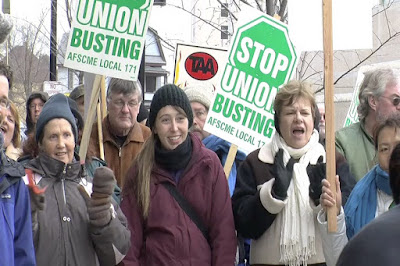 The political quake that shook all those Dems out of office in November 2010 did a particularly nasty number on Wisconsin. The state's legislature was stormed by the GOP, which now has majority control both the assembly and senate, and the governor's office was seized by yet another Republican candidate. These conservative victories have rolled out the red carpet for austerity measures to advance, and have painted targets squarely on public employees.
Newly-elected governor Scott Walker's plan to address the state's $137 million deficit calls for public employees to assume a roughly 7 percent pay cut through increased contributions to their pensions and health insurance costs. Walker is also working to push a union-busting bill through the legislature, which would strip public employees of an obscene portion of their collective bargaining rights and threatens striking workers with termination. The starkest example that the good governor is ready to play rough is his willingness to respond to an uprising by calling in the National Guard. (Makes me wonder where he's getting his leadership advice.)
While it's disconcerting to see how much Wisconsin can resemble an autocratic nation, it's electrifying to see its people rising up. More than 25,000 people stormed the state capitol and every Democratic senate member fled the state to prevent a vote on the anti-union bill (at least one Democrat has to be present for a vote to be held).
State Rep. Alberta Darling defended the Republican plan, saying, "We don't have a lot of options here folks. It's not like we're choosing to do this. We are broke."
Of course, that's if you don't consider raising taxes on Wisconsin's most financially enriched – who are most able to help preserve the state's services and infrastructure and narrow the deficit – to be an "option." Corporate tax loopholes allow two-thirds of Wisconsin's corporations to pay nothing into the state coffers, so it's not hard to see why that revenue stream has dried by half in recent decades. A failure to act on that fact begs the question of who or what Gov. Walker is representing.
The question of what collective bargaining has to do with balancing the budget has been raised on several fronts. Georgetown University labor historian, Joseph McCartin, asserted:
"If it had simply to do with the budget there doesn't seem to be a need to eliminate collective bargaining...In other states where state's municipalities have faced difficult times, unions have helped negotiate the way forward."
Russ Feingold, former U.S. senator for Wisconsin, was unequivocally opposed to the Governor's anti-worker agenda. He even provides insight into the mystery of on whose behalf Gov. Walker is acting:
"I don't think there's any question that what Gov. Walker is trying to do here is not simply outrageous -- one of the worst things I've ever seen a Wisconsin governor do -- but he's just acting on a long-time corporate wish: the fantasy of destroying unions."
Interestingly, it's not just the usual suspects speaking out against the Governor's plan. An organized group of veterans have condemned Walker's use of the National Guard as an "intimidation force." And, members of the Super Bowl winning Green Bay Packers have come out in support of the AFL-CIO's efforts to fight back.
Our focus and admiration should be on the actions and resolve of the protesters and state legislators who have chosen to support the working people of Wisconsin.
This isn't just their battle, it's all of ours. If the sadists among the Badger State's legislature succeed in passing this bill, we should expect more of these battles to emerge across the country as copycat legislation gets drafted.
The stakes are high, so we need to support their efforts, spread the word, take good notes and be ready to prevent what could come to our states next.
Here's some footage of a rally at Wisconsin's statehouse. You don't get a turnout like this without good reason.
State Groups Tackle Tax Fairness
 It’s July 2010, and organizers from 10 state-level grassroots groups have traveled to Washington, D.C. Rob Brown of Opportunity Maine is at the front of the room addressing the crowd. “Firefighters and other local law enforcement are key allies in property tax-cap campaigns,” Brown says, as listeners scribble in notebooks and clack on laptops. “Their perspective tends to be universally appealing to even the staunchest skeptic.”
At the event, Brown shared best practices and lessons from Maine’s successful campaign to defeat a property tax-cap ballot initiative with leaders of grassroots state tax-fairness organizations from across the country. All groups are members of the Tax Fairness Organizing Collaborative (TFOC), a coalition of 28 grassroots groups in 24 states working to promote progressive-tax reform. Progressive taxes, such as the federal income tax, require upper-income people to pay more of their income in taxes than those with lower-incomes. This is different from a flat tax, such as a sales tax, which applies the same tax rate to all individuals regardless of income level. Thus, flat taxes take a higher portion of income from low-income people than from high-income people.
The TFOC is a project of United for a Fair Economy, a national economic-justice advocacy organization. The TFOC operates in stark contrast to the brassy, anti-tax, antigovernment Tea Party. The TFOC believes that government enhances quality of life and that collecting government revenue through taxes is a necessity that should be done fairly, responsibly, and through policies that reflect our society’s values.
In some communities, organizing work to promote tax fairness has taken place for decades. But in early 2000, the movement came to a head, following the bursting of the technology bubble and waning government support for public services. As more people felt the effects of severe budget cuts and imbalanced tax policies, the movement gained momentum. By 2004 the TFOC launched to strengthen state-level efforts and facilitate connectivity across state lines. The TFOC has filled an important role in the progressive movement by providing a national infrastructure for tax-fairness organizers to collaborate, share best practices, problem-solve, and learn the latest in communications from pollsters and researchers. Through the TFOC, grassroots leaders regularly convene in affinity groups to tackle common issues, such as no-income-tax states, conservative states where taxes are limited, and states fighting corporate tax loopholes. The emphasis on grassroots organizing distinguishes the TFOC from other progressive tax-policy organizations and networks.
In the states, the tax fairness movement is firmly in place. And the work is more important than ever. From New York to Nevada, grassroots organizations have led the fight for progressive and adequate revenue to support the schools, bridges, parks, and other public resources that keep our communities strong. To a large extent, these organizations are part of coalitions that include teachers, seniors, human-service associations, community organizations, unions, faith-based organizations, and various nonprofit advocacy groups. A snapshot of the work taking place in states across the country paints a hopeful picture:
- Washington. Washington Community Action Network has led the field campaign to pass I-1098, a November 2010 statewide ballot initiative to cut property taxes and taxes on small businesses to benefit the middle class and establish a high-earners income tax for the wealthiest 1.2 percent of households (that is, families earning more than $400,000 annually, or individuals earning more than $200,000 a year).
- Alabama. Alabama Arise has worked to remove the state sales tax from grocery purchases and to pay for it by eliminating the state tax deduction for federal taxes paid, which benefits primarily the wealthy.
- Colorado. The Colorado Progressive Coalition (CPC) has co-led the fight to defeat three measures on the ballot in November 2010 that would cut state and local taxes, fines, and fees and prevent the funding of long-term infrastructure projects. CPC plays an integral part in the campaign to defeat these initiatives by running the fieldwork operation, coordinat- ing messaging throughout the state, and providing community-level education.
- Tennessee. Tennesseans for Fair Taxation’s overarching goal is to modern- ize the state’s tax system. This includes working to reduce the general sales tax, eliminate the tax on food, and implement a personal income tax with generous exemptions for low-income families.
- Nevada. The Silver State has been hit hard by the recession, unemployment, and the foreclosure crisis, particularly because of its long-standing reliance on gaming taxes and regressive sales taxes. The Progressive Leadership Alliance of Nevada advocates creating new sources of revenue to support critical public services, including extraction taxes on the state’s gold-mining industry.
In communities across the country, great grassroots work is happening, but the challenges remain acute. As more families are having trouble making ends meet, countering the anti-tax rhetoric is particularly challenging. But we all have a vested interest in our government’s tax system, since fair and adequate revenue is critical for our communities to thrive. And through the tax fairness movement, state-level grassroots organizations and their allies are working to rebuild—from the bottom up—a more progressive tax system that reflects values of fairness, responsibility, and sustainability.
Karen Kraut is a coordinator at the Tax Fairness Organizing Collaborative. Shannon Moriarty is the TFOC’s communications director.
Learn more about these TFOC member groups:
|
|
 |
 |
 |
|


By Shannon Moriarty and Karen Kraut. This column appeared in the Fall 2010 issue of The Nonprofit Quarterly.
Why Support the Higher Education Transparency Act?
 This week, Massachusetts residents have an opportunity to advance the movement for economic justice in the Bay State by urging their state representatives and senators to support the Higher Education Transparency Act.
Massachusetts' private colleges and universities, which are designated as non-profit organizations, enjoy tax exempt status while also receiving direct federal and state subsidies. That's because of their primary functions—to educate and to provide opportunities and services to their communities.
And yet, we too often witness the same taxpayer-subsidized institutions—some with multi-billion dollar endowments—engaging in profit-motivated behaviors, such as tuition hikes, casino-like investing and layoffs.
Also, as this rececession forces average American workers and their families to "tighten their belts," the leaders of some of these colleges and universities are being paid over a million dollars a year.
Economic recovery requires shared sacrifice.
This bill would strengthen the financial disclosure requirements for Massachusetts’ private, non-profit colleges and universities by mandating more thorough reporting on employee compensation; how endowments are invested; agreements with outside consultants, and the total tax subsidies they receive.
Additionally, it would give the public and the legislature a way to evaluate the financial choices being made by institutions of higher learning, and the values under which they operate.
Here is a summary of the provisions of the Higher Education Transparency Act:
- Affects private, nonprofit colleges and universities and their related organizations who have investments (defined as value of, not interest on) or real property over $10 million dollars;
- Requires the schools to calculate the received benefit from all tax exemptions;
- Mandates individual conflict-of-interest disclosures by trustees or directors of the institution;
- Mandates disclosure of payments of greater than $150,000/year to outside individuals or firms for advice or services;
- Mandates disclosure of payments of greater than $150,000/year from outside individuals or firms for advice or services;
- Mandates disclosure of the names and titles of anyone making more than $250,000 year;
- Requires the Attorney General to set the method and scope by which tax calculations and disclosures are done;
- Requires disclosure of the names, amounts, and descriptions of services provided to and from vendors.
Our friends at SEIU Local 615, which represents janitors, security workers, and other property service workers in MA, RI, and NH, are leaders in the fight for this rule change to hold private, non-profit colleges and universities in Massachusetts accountable. Visit their campaign page for more ways to get involved.
If you want to add your voice to this campaign, be sure to call your elected officials by Friday, February 4th! (Click here to find your elected officials.)
The High Price of Austerity
 Austerity is the political buzzword these days. As politicians from both parties are jumping on the “starve the beast” bandwagon, few are considering the long-term impacts of the approach. What seems like tightening the belt today will likely cost us much, much more down the line.
On the subway this morning, when I grabbed an issue of the Metro for my half hour ride to work, this headline stopped me in my tracks: "HIV/AIDS funds take steep cuts in proposal."
Deval Patrick, a Democrat, and the only Black Governor in the country, had recently announced his proposed 2012 budget. In it, HIV/AIDS funding takes a whopping $2 million hit. That’s the largest proposed cut to HIV/AIDS funding in 20 years!
To make matters worse, the burden of these cuts would be disproportionately felt by communities of color. The article pointed out that Blacks and Hispanics each make up only six percent of the state's population. Yet, Blacks comprise 28 percent of HIV/AIDS patients and Hispanics 25 percent.
Sadly, this is right in line with the findings of United for a Fair Economy’s 2011 State of the Dream report: "Austerity for Whom?", released just last week. It’s shocking that here, in the liberal Commonwealth of Massachusetts, a proposed roll back of necessary programs will so disproportionally disadvantage people of color.
The most frustrating part of Governor Patrick’s proposed slashing to HIV/AIDS program budget is that, in the long run, it won’t save much money at all. In fact, it will probably cost us more. Emerson Miller, a program manager for AIDS Action, points out in the article that the investment in HIV/AIDS prevention and treatment actually "saved the state millions of dollars in potential health care costs over the last 10 years."
In other words, investing $2 million dollars in the preventative health of Massachusetts residents today will save us millions in treatment over the next decade. Not to mention preventing pain and sickness for a whole lot of people. That seems like a no-brainer.
Instead, deficit hawks in both political parties are supporting the “starve the beast” approach. This, combined with the lack of political will to raise revenue by restoring taxes on the top five percent, means that the rest of us will pay more down the line. And low-income folks—particularly people of color—well, they will just die sooner.
Austerity should mean cutting unnecessary government spending. Not eliminating smart investments in the health of our people and our communities.
A Win for an Invisible Workforce
 What if you worked long, hard days in others' homes, cleaning, cooking, or caring for others' children or disabled family members; or if your workplace were in the fields of crop that feed American families, under the unforgiving heat of the sun and charge of a demanding employer — honorable work, to be sure — and yet, you weren't even covered by the most basic of federal labor protections?
That's precisely the case for domestic workers and farm workers throughout the U.S., who are also predominantly migrant workers of color, as mentioned in UFE's report, State of the Dream 2011.
In addition to a general lack of basic worker rights, exclusion from safety net programs, like social security, intensifies these workers' struggle for economic stability.
But, momentum is building to ensure rights for this invisible workforce. In summer 2010, New York state opened the doors for broader reform by passing a Domestic Workers' Bill of Rights. A major organizing force behind this victory was Domestic Workers United (DWU), a NY-based group that is "organizing for power, respect, fair labor standards and to help build a movement to end exploitation and oppression for all."
A recent report (pdf) by DWU, National Domestic Workers Alliance and Urban Justice Center discusses the bill's good points, the work that remains to be done, and the way forward in an age of new rights in New York. As support builds for fair labor laws, and for a more broadly inclusive economy, victories like this will pay political dividends to workers in other industries like agriculture.
DWU member, Christine Lewis, went toe-to-toe with Stephen Colbert to raise public awareness of the challenges faced by domestic workers, to discuss the importance of their work, and to show that when people unite for a just cause, history can be made.
| The Colbert Report | Mon - Thurs 11:30pm / 10:30c | |||
| Christine Yvette Lewis | ||||
| ||||
Stories, Not Stats, Win Hearts and Minds
 If during last night's State of the Union address, you were more moved by Obama's words than by Michele Bachmann's PowerPoint charts, you're not alone. Sure—data has it's place. But when it comes to inspiring people and garnering the support necessary to create change, it's all about the stories we tell.
In last night’s State of the Union address, President Obama used a story that evoked our shared memory, history, and pride.
“Half a century ago, when the Soviets beat us into space with the launch of a satellite called Sputnik, we had no idea how we would beat them to the moon. The science wasn't even there yet. NASA didn't exist. But after investing in better research and education, we didn't just surpass the Soviets; we unleashed a wave of innovation that created new industries and millions of new jobs. This is our generation's Sputnik moment.”
Using that Sputnik narrative as his starting point, he then made the case for meeting the challenges of our generation with large-scale investments in clean energy, information technology, and biomedical research. Regardless of what one may think of the overall message Obama delivered, the method is right on.
He could have stood up there and cited statistics from Mark Zandi of Moody’s about how each federal dollar we spend in infrastructure investments generates $1.59 in economic stimulus, but that would have fallen flat. Worse, it would have been met with skeptics who have adverse knee-jerk reactions to “government spending” of any kind. Instead, he used a powerful story that evoked a sense of pride, and in doing so re-framed the debate based on our shared history and understanding of the world. That’s how we are going to win hearts and minds.
It is through stories like these that we are able to process new information and facts. Jeff Chang and Brian Komar expanded upon this concept in an article entitled, “Vision: Bringing our Culture into Progressive Politics is a Winner,” posted on Alternet today.
“Culture is the space in our national consciousness filled by music, books, sports, movies, theater, visual arts, and media. It is the realm of ideas, images, and stories -- the narrative in which we are immersed every day. It is where people make sense of the world, where ideas are introduced, values are inculcated, and emotions are attached to concrete change…”
That is, culture – in the form of stories, shared experiences, metaphors, and the like – is the way in which people make sense of the world. It’s the way in which facts are processed. This understanding has greatly informed the work of United for a Fair Economy (UFE). It’s part of the reason we have put the stories and culture of change at the forefront of our work.
- Stories: When discussing her support for a progressive tax system and strong estate tax at a UFE press conference, Abigail Disney made a compelling case about how her family’s wealth (she is the granddaughter of Roy Disney, Walt’s brother and business partner) would not be possible if it were not for the highways that brought Americans to Disneyland and the courts that protected the copyright of Mickey Mouse.
- History: In our most recent State of the Dream report, we retell the story of how the broadly-shared prosperity of the 1950s and 1960s was created through massive public investments in infrastructure and people – the interstate highways system, aerospace industry (Obama’s Sputnik story), and the GI Bill – interwoven with the story of race in America.
- Art and Theater: To explore inequality in our workshops, we use a popular UFE exercise involving 10 chairs and 10 volunteers. Each chair represents 10% of the wealth and each person represents 10 percent of the population. By the end of the workshop, one person representing the top 10 percent is laying across seven chairs while the remaining nine are crammed onto the last three chairs. These exercises create a powerful set of shared experiences for participants that are far more memorable than watching a Powerpoint presentation.
Clearly, much work remains to be done, but the road ahead is clear and it’s lined with the stories, history, art, and shared experiences that define our culture.
When Society Attacks: Race and People Devalued
As we close in on Black History Month, the soothsaying jesters at The Daily Show have—in brilliantly hilarious fashion—taken heed of the ways racism continues to rear its ugly head in modern day.
UFE's 2011 Martin Luther King, Jr. Day report, citing the groundbreaking book, The Spirit Level: Why Greater Equality Makes Societies Stronger, acknowledges some of the societally damaging effects of economic policies that fail to account for the factors of race and inequality.
In the video below, The Daily Show's Wyatt Cenac builds on that, revealing how nasty things can get when society attacks, history is ignored, people are devalued, and the most marginalized communities—like Turkey Creek, MS—are nearly wiped from existence.
Are You a Socialist?
 If you support a progressive tax system, does that make you a "socialist?"
A progressive tax is one where the tax rate increases as the taxable base amount increases. In plainer terms, it's one that levies a fairer share from those who have reaped the greatest financial benefits from our many taxpayer-funded economic structures.
Chances are, if you vocally support a progressive tax system, you’ve dealt with such accusations at one point or another.
Perhaps, like me, your knee-jerk reaction is to get angry. Or to accept the name-calling, figuring it just comes with the territory of being "on the left," so to speak. But Steve Schnapp, a popular educator with United for a Fair Economy, offers a more constructive approach.
Steve was recently interviewed for a forthcoming documentary by Will 2 Power Productions. In the interview, he explained how he responds to progressive activist concerns of being labeled with the 's' word.
“You can call it socialism, you can call it whatever you want,” he said. “Here’s what I stand for: equity, fairness, helping each other out. Some folks like to call that socialism, and they think if they just paint us with that brush, it will end the conversation…But I believe that these are values we all share.”
Steve’s point is a good one (and well-articulated, as you’ll see below). Whether it’s in the halls of Congress or at our kitchen tables, it’s important for each of us to remember the values that unite us rather than the partisanship that seems to divide us. After all, writing each other off with labels squashes any potential for dialogue.
With an open mind, we're more likely to find that we have much more in common with our political “adversaries” than we think.
One Man's Reponse to "Socialist" Accusations from United for a Fair Economy on Vimeo.
The Divide Deepens
Proposed 10% Cut to Federal Workforce Will Deepen the Racial Divide in the U.S.
Late last week, the Washington Post ran a story about a bill introduced by Representative Kevin Brady (R-TX) to cut the federal work force by 10 percent in the next decade. Three days later, UFE released our new State of the Dream report which documents, among other things, the disproportionate impact that federal employee cutbacks will have of Black families.
It’s important to remember that public sector workers perform very important functions in our society that benefit Americans of all races. Public sector workers are the ones who inspect our food supply, police our streets, and educate our children. As a result, attacks on the public sector and its workers hurts all Americans regardless of race by eroding the ability of our nation to meet the needs of its citizens.
At the same time, the proposed cuts to the federal work force will disproportionately hit Black workers who are more likely to be employed in public sector jobs. In fact, Blacks are 30 percent more likely to work a public sector job than the general work force, and 70 percent more likely to work for the federal government in particular.

For Blacks, the attack on the public sector workforce is a one-two punch. In addition to the eroding ability of our nation to meet the needs of its citizens, Black workers will shoulder the brunt of the layoffs at a time that the Black unemployment rate is 15.8 percent.
Read It, Share It, Take Action — State of the Dream 2011
 Just in time for Martin Luther King, Jr. Day, we released our 8th annual report on racial economic inequality in the United States.
This year's report, State of the Dream 2011: Austerity for Whom?, surveys the impact of a belt-tightening, deficit-reducing, tax-cutting and, ultimately, government-shrinking economic agenda on communities of color.
Our research explains that if such an austerity agenda advances, Dr. King's dream of racial equality in the U.S. will be pushed further out of reach.
- Read a summary of the report.
- Watch a video of co-authors, Brian Miller and Mazher Ali, discussing key points of the report.
With this report, we are calling on Americans of all races to stand up for a more racially just and inclusive economy – one that brings people together, rather than tears us apart. We hope you'll help us spread the word.
Here are ways you can help:
- Share this email and the report as broadly as you're able. Use social media to get this information into your online networks.
- Read the report and write op-eds, letters to your local editors and/or blog about what it means to you.
- Have conversations with your family, friends, colleagues and other community members, and ask them to do the same.
- Stay informed on the issues outlined in State of the Dream 2011, and other issues of racial inequality, and take every opportunity to share your positions with your elected officials.
Also, on MLK Day this Monday, January 17th, consider participating in a day of service as a way to honor Dr. King's legacy.
"Now is the time to lift our nation from the quicksands of racial injustice to the solid rock of brotherhood."
– Dr. Martin Luther King, Jr., "I Have a Dream" speech, Washington, DC, August 28, 1963
Happy MLK Day.
Video: The State of MLK's Dream
 MLK envisioned a work where the color of one's skin mattered about as much as the color of one's toothbrush. Sadly, the juxtaposition between the beauty of MLK's dream and the reality of racial and economic equality in America today is startling.
According to a new report released today by United for a Fair Economy—State of the Dream 2011: Austerity for Whom?—the racial economic divide in this country remains significant. For example: for every dollar of net wealth held by Whites, Latinos hold 12 cents and Blacks hold just 10 cents. Blacks are 90 percent more likely and Latinos are 50 percent more likely to be unemployed, and those who do work earn significantly less than their White counterparts—Blacks earn 57 cents and Latinos earn 59 cents to each dollar of White median family income.
Austerity measures supported by GOP and Tea Party activists will hurt all of us who rely on good schools, safe roads, and strong communities. But beyond that, austerity measures will simply worsen the economic inequality and prevent us from realizing Dr. Martin Luther King, Jr.'s dream.
This video features Mazher Ali and Brian Miller of United for a Fair Economy, two of the co-authors of the report, discussing the key findings of the report.
Check out a summary of State of the Dream 2011 or download the report in its entirety.
State of the Dream 2011: Austerity for Whom? from United for a Fair Economy on Vimeo.
Remembering Felice

A dear friend to and warrior for the social justice movement, Felice Yeskel, left this world on Tuesday, January 11, 2011 after a hard-fought battle with cancer. She will be sorely missed.
My first substantial encounter with Felice was as a participant in a 3-day training of trainer (TOT) event being run by Share the Wealth, the organization that Felice and Chuck Collins co-founded, and which they ran as co-directors. (Shortly after that, Share the Wealth changed its name to United for a Fair Economy to better represent our “big tent” strategy of addressing the growing economic divide.)
Felice (with Chuck) led the TOT, and I, newly hired to bolster UFE’s popular economics education program, was daunted by her fantastic training skills, sharp intellect, and above all, the warmth and respect shown toward all the TOT participants. I was not a newbie to this kind of work, with 30 years of organizing experience and five more leading popular education TOTs. Yet I was wowed again and again by her amazing ability to teach, engage, encourage, and challenge in ways that lifted us all.
Although Felice moved to Amherst and worked mostly from a distance, gradually reducing her role at UFE, I continued to observe, support, or co-lead UFE workshops and TOTs alongside Felice over the next couple of years. Much of the success of my educational work to date is the direct result of her wisdom and mentorship.
One example of the many things I learned from Felice was a strategy of responding to discordant anger from a workshop participant. Felice referred to the strategy as a "jiu-jitsu" approach – using the momentum of an attack to unexpectedly draw a person in, rather than strike back, welcoming their energy and passion without necessarily condoning their behavior or the content of their comments. She advised that trainers be curious, allow space for challenges, yet always respect the expectations and integrity of the group by purposefully keeping the dialogue moving forward. Felice was the master at this, and set a high bar for aspiring popular educators.
Of course, Felice was much more than an incredibly skillful educator. She was a loving mom and life-partner, a mentor and a friend to innumerable people, an active community member and good neighbor, a wit and enthusiast of fine (and not-so-fine) literature, and much more.
Felice and I also shared an appreciation for our New York City working class Jewish roots. She, however, brilliantly incorporated this life experience and a scholarly study of class into an analysis and a set of strategies for action. That ability helped Felice to give birth to UFE and, later, to Class Action (which she co-founded with Jenny Ladd and directed until her battle with cancer forced her step back).
There is so much more one can say in tribute to Felice. I look forward to learning more about this remarkable woman and to reading and hearing the tributes and recollections that are beginning to pour into various websites.
I don’t think I would be at UFE – now going on 13 years – if not for Felice. I’m not sure whether UFE would be here if not for her vision and persistent effort. We are immensely grateful for her gifts to us and our deepest sympathies go out to her partner Felicia, her daughter Shira, and all the many members of her family, communities, colleagues, and friends.
Felice Yeskel, presenté.
A beautiful video by Lawrence Bush, editor of Jewish Currents magazine, in memory of Felice and others recently lost:
Photo above by Jerrey Roberts for The Amherst Bulletin
State of the Dream 2011 | Media Coverage
Select Coverage of State of the Dream 2011: Austerity for Whom?
 State of the Dream 2011: Austerity for Whom? surveys the impacts of a tax-cutting, government-shrinking economic agenda – as prescribed by Republican leadership with Tea Party allies – on communities of color.
We find that if such an agenda advances, the dream of a racially equal society, as described by Dr. Martin Luther King, Jr. over four decades ago, will be pushed even further out of reach.
If you are a media representative or blogger on social and economic issues and are interested in covering this report, please contact Maz Ali at 617-423-2148 x101 and/or [email protected]. Scroll down for select media coverage of this report.

February 27, 2011
Economic parity dream needs a second wind
The nearly 400-year history of black people in America has always been a race to catch up. Recent data shows that history has not changed.
United for a Fair Economy last month released its “State of the Dream Report” showing that African Americans have only 10 cents in net wealth compared with 12 cents for Latinos and a dollar for whites. [...]
Joblessness is a major problem, too, among people of color. This is a “who you know” job market, which embraces white privilege. [...]
The...report also found that...whites are three times as likely as blacks and 4.6 times as likely as Latinos to benefit from the tax breaks for those earning more than $250,000. The report also shows that the benefits of the reduced tax rate for capital gains and dividends flowed “overwhelmingly to whites.”
That and the weakening of the estate tax will continue to widen the wealth gap. Again, this is the disadvantaged history of blacks in America, beginning as people who were property by law.
Read the full column by Lewis Diuguid on KansasCity.com.

February 24, 2011
The dirty secret of public-sector union busting
Look a little closer at who really stands to lose if Scott Walker gets his way: Women and minorities
Amid all the rightful outrage over Gov. Scott Walker's proposal to do away with collective bargaining rights for public sector unions in Wisconsin, one important point has been neglected: The demise of public sector unions would be most detrimental to women and African-Americans, who make up a disproportionate share of the public sector workforce. [...]
According to a report by the nonprofit United for a Fair Economy, blacks are 30 percent more likely than the overall workforce to hold public sector jobs.
Read the full post by Alyssa Battistoni on Salon.com

February 23, 2011
"We're Broke," Say the Rich, and the Poor Must Pay
Racism is the salvation of late-stage American capitalism. For hundreds of years, real facts of human existence have been routinely turned on their heads, and non-facts accepted as ultimate truths, all to justify white supremacy. A society so afflicted can believe literally anything. Thus, the Republicans achieve wondrous success by planting the words "We're broke" in the mouths of men and women who are transparently rich, and who in turn serve the interests of the super-rich. [...]
This governmental brokenness coexists with December's Obama-GOP two-year, $850 billion tax giveaway, 40 percent of which goes to the top five percent of income earners, while 25 percent will go to the top one percent, according to the United for a Fair Economy.
Read the full column on OpEdNews.com.

February 19, 2010
In Rough Times, Black Americans Remain Optimistic
When asked recently how they feel about their future, 85 percent of blacks said they are optimistic, with 65 percent indicating they specifically feel secure about their financial situation... [...]
Fifty-six percent of blacks, compared with 44 percent of whites, said the current economic situation is not causing stress in their lives.
The confidence level of blacks in the race and recession survey is in stark contrast to the depressing economic data showing that the economic crisis is still plaguing the African American community. [...]
Read the full column by Michelle Singletary on WashingtonPost.com.

February 10, 2011
The Recession May Be Over, But the Misery is Not
Black and Latino families are continuing to disproportionally experience economic hardship, points out another report from the Boston-based research organization United for a Fair Economy. The reason is that they entered the recession with a meager cushion. In 2007, blacks had only a dime and Latinos 12 cents of assets compared to every dollar whites had.
“Very clearly, they don’t have the wealth to withstand and to endure economic hardships in the same way white families are able,” says Mazher Ali, a co-author of the report.
Read the full column by Eva Sanchis on Progressive.org

January 28, 2011
Hard-Knock (Hardly Acknowledged) Life
So how is it that this Democratic president has the temerity to deliver a State of the Union address that completely neglects any explicit mention of the calamitous conditions now afflicting his staunchest supporters: the poor? [...]
And things could get even worse for the poor if the president feels the need to cut too many deals with the new Republican-led House in order to appear more centrist.
According to Brian Miller, the executive director of the nonpartisan and Boston-based group United for a Fair Economy and co-author of the group’s report entitled “State of the Dream 2011: Austerity for Whom?” released earlier this month, “austerity measures based on the conservative tenets of less government and lower taxes will ratchet down the standard of living for all Americans, while simultaneously widening our nation’s racial and economic divide.” [...]
Read the full column by Charles Blow on NYTimes.com

January 24, 2011
The world has changed since Dr. Martin Luther King, Jr. shared his dream on the National Mall in 1963. But this year, during Black History Month, we should remember that King's messages remain as powerful--and necessary--today.
Nearly 43 years after King's assassination, the racial economic divide in our country endures. And if the austerity agenda advocated by deficit hawks in Congress succeeds, the state of King's dream is sure to decline.
MLK once said, "I believe that unarmed truth and unconditional love will have the final word." The unarmed truth--or data, in this case--is startling.
Read the full post by Wanjiku Mwangi of United for a Fair Economy.

January 20, 2011
GOP Austerity Plan is an Assault on Blacks and Latinos
"Them that's got shall get. Them that's not shall lose," as the Billie Holiday song goes. "Yes, the strong gets more while the weak ones fade. Empty pockets don't ever make the grade."
It is a tale of two cities in early twenty-first century America. Wall Street is enjoying hefty bonuses and corporate America is awash in cash. Yet, all you can hear, whether inside the Beltway or around state houses is talk of austerity, the new buzzword that's all the rage. Conservative politicians in Congress and in statehosues around the country rode a wave of Tea Party pseudo populism, funded by Republican philanthropy, corporate lobbyists and the U.S. Chamber of Commerce.
Read the full post by David A. Love.
January 19, 2011
GOP Austerity Plans Will Widen Racial Economic Divide, Report Says
Countries around the globe have gone from implementing stimulus packages to austerity measures as a model for economic recovery. The new Republican-led House of Representatives here in the United States is now mounting up a campaign of its own.
Eliminating social service programs, tax cuts for the rich, and rolling back public sector employees are all on the GOP agenda. But a new report argues that these policies will further widen economic inequalities for U.S. minorities and the public at-large.
The Boston-based nonprofit United For a Fair Economy published the findings last Friday to highlight Dr. Martin Luther’s King vision for economic justice. The analysis is not only a rebuke to the House majority’s policies, but also stands in stark contrast to a recent International Monetary Fund report that suggests countries should continue promoting fiscal austerity.
Read the full column by Akito Yoshikane on InTheseTimes.com

January 17, 2011
President Obama Does Fulfill King's Dream
Nearly a half century after King's I Have a Dream words the black poor are still just as tightly trapped in the grip of poverty and discrimination that King warned about. On the eve of the King national holiday and Obama's second year in office, the Boston based research and economic justice advocacy group, United for a Fair Economy, released its eighth annual King Day report. It found that the gaping disparities in income, wealth, employment, quality and availability of housing, decent schools, and health care between blacks, minorities and whites has grown even wider.
Read the full column by Earl Ofari Hutchinson on HuffingtonPost.com.

January 17, 2011
The Revolutionary MLK
Making King Bland: Every year on MLK Day, a bland liberal version of Martin Luther King is celebrated, and leftists take time to point out how radical King was, toward the end of his life, at any rate. Two contributions of note. [...]
Read the full post by Chris Sturr on DollarsandSense.org.

January 17, 2011
"State of the Dream" on Pacifica Radio, Los Angeles
 Mazher Ali, of United for a Fair Economy, talks about the new report, "State of the Dream 2011: Austerity for Whom?"

January 17, 2011
When judging the state of King's dream for economic justice, the verdict is clear: Black America faces a nightmare.
African-Americans bore the brunt of the Great Recession's job losses and economic slow-down. And it only promises to get worse: The slash-and-burn agenda proposed by the new Congressional House leadership, as well as many state legislatures, will have a uniquely devastating impact in low-income and black and Latino communities.
Just how bad? A new report by United for a Fair Economy offers a valuable survey of the damage that's already happened, and how it will likely get much worse.
Read the full post by Chris Kromm on SouthernStudies.org.
January 17, 2011
Black Americans Especially Vulnerable To Budget Austerity, Study Shows
Whenever governments cut spending, the pain is uneven.
But African Americans are especially vulnerable, as a disproportionately high number rely on government dollars for crucial services, a new study has found. As black people are more dependant than white people on public safety nets, and are more likely to be on public payrolls, governmental austerity could wound the black community especially severely.
Read the full column by William Alden on HuffingtonPost.com.

January 16, 2011
Austerity for whom?
"[B]ecause we exist in a society that has an infrastructure and legacy of racism, the effect of these policies is the same as explicitly racist ones. For example, if you work at the DMV in your state and you're a minority, it probably will seem very much like racism to have your job eliminated while simultaneously the wealthy White guy at your counter is registering his new Bentley as a result of his brand new tax cut. Especially if half your co-workers are of color and most of the new luxury vehicle registrations are from people who are White."
Read the full post on DailyKos.com.

January 15, 2011
Are We At A Tipping Point? State of the Dream 2011
Just the other day, though, one of my more socially liberal friends forwarded a story about how the top 1% has seen massive wealth increases in the last 30 years while the lowest 40% have seen not only a drop, but have fallen into the negative wealth zone (owing more money with very little assets).
Could this finally be a tipping point? [...]
Just in time for that tipping point, my friends at United for A Fair Economy have released their 2011 State of the Dream Report. With the Republican majority in the House demanding “austerity,” and Democracts likely to join them on some of their agenda items, this report shows who will get hurt the worst by “centrist” economic policies.
Read the full post by Craig Wiesner.

January 14, 2011
State of the Dream 2011
As we prepare to observe MLK Day Monday, we take a look at the "state of the dream"
The group United for a Fair Economy released a report today that sheds some light on how far we've come in realizing Dr. King's dream.
It shows that current public policies worsens the racial economic gap...hitting African Americans and Latinos hardest.
Read the full post by Nordia Epps on WDEF.com.

January 14, 2011
The Austerity Agenda and the State of the Dream
In advance of Martin Luther King Day next Monday, United for a Fair Economy has released its 8th annual "State of the Dream" report, surveying the economic challenges facing workers of color. The 2011 edition focuses on the impact of economic austerity on African American and Latino workers.
The report documents several ways in which the austerity agenda sweeping Washington hurts the African American and Latino middle- and working-class.
Read the full post by John Schmitt.
Take a Stand for a Filibuster Rule Change
 There are few Congressional theatrics as dramatic as the filibuster. In the movies, in order to filibuster, Senators must bravely stand in the Senate and passionately make their case to the American people.
But in today's modern Senate, things have become downright lazy. Rather than taking a bold stand of impassioned principle or courage, Senators can filibuster by placing a phone call to a clerk and heading off to a leisurely dinner. The mere threat of a fillibuster is often enough to stop legislation dead in its tracks. What's worse, the lack of a strong filibuster has contributed to the worst partisanship and gridlock we've seen in decades.
This January 5th, we have an important opportunity to demand that the rules of our Senate change. We can demand that our elected officials go on the record with their positions in an all night talk-a-thon in order to block legislation or nominations.
Senators Jeff Merkley (D-OR) and Tom Udall (D-NM) are calling for a new filibuster rule to make the voice of the minority heard and to make the Senate more productive. This new rule must be adopted on the first day the Senate convenes next year, when only a simple majority of Senators is required for a change in Senate rules.
Take a stand today to demand that your Senators take a stand! If you want to return to the days of Mr. Smith, take action today! Call your Senators by January 5 and ask them to support the improved filibuster rule.
On Taxes, Race Matters
Ninety-seven percent of Americans got the muddy end of the stick in the lopsided tax bill President Obama signed into law in December. Of that 97 percent, people of color will suffer the most.
When it comes to tax policy, the national conversation typically fails to account for race as a factor. So, although the progressive tax movement suffered a setback in the Obama-GOP tax deal, the debate offered reason for hope in the coming two-year battle over the estate tax and top-tier Bush tax cuts.
The Congressional Black Caucus stepped up to express its overwhelming distaste for the tax deal. In doing so, those legislators have signaled their awareness of the connection between tax breaks for the super-rich and the economic backsliding of African American communities. CBC member Rep. Jesse Jackson, Jr. likened President Obama's tax plan to Reaganomics:
"I'm worried that the deal President Obama cut with Republicans sets us up for a Reagan-style set of bad choices…That was President Reagan's strategy: a 'starve the beast' plan of lowered taxes and increased military spending that would force Congress to make deep cuts in programs for the most vulnerable."
The CBC wasn't alone in their outrage. A group of Black church leaders, representing 50,000 congregations, loudly denounced the tax deal. Reverend W. Franklyn Richardson, chairman of the Conference of National Black Churches, wrote:
"Based on our prophetic responsibility to speak to those in power on behalf of the poor, underserved, and vulnerable, we find it utterly shameful that those who insisted that the deficit be reduced, now celebrate billions of dollars being added to the deficit as tax cuts for the wealthy."
Latinos are also among those to feel the scald of poor tax policy. Oscar Chacón, Executive Director of the National Alliance of Latin American and Carribean Communities (NALACC), explains the insecurities Latinos, like African Americans, face in the Obama-GOP tax deal:
"The continuation of the Bush tax cuts for the richest 2% in this time of crisis is an utterly irresponsible act. With the incoming Congress, it is foreseeable that the significant increase in federal debt generated by this "compromise" will be used as a leading argument to enact cutbacks in key social programs that will inevitably have a disproportional negative impact on Latino and Latin American immigrant communities in the U.S."
In the short-term, a worrisome finding in the Obama-GOP tax plan is that the poorest Americans would experience a slight tax increase due to the replacement of the President's "Make Work Pay" tax credit with a temporary 2 percent cut to the payroll tax. Workers of color are strongly represented in the lowest tax brackets, and would therefore carry a disproportionate amount of the weight of that tax hike.
The payroll tax cut itself is like whiskey in a Red Bull can. Measures that cut holes in safety net programs–as this cut threatens to do with Social Security–are dangerous for the working class and people of color, who are more likely to rely on those programs than white Americans. If the payroll tax cut now is used as a reason to cut benefits later, the overall economic impact will be more contractionary than stimulative.
In determining which way is forward, we must constantly consider the type of society in which we want to live. At the most basic level, many of us want the same things, regardless of race or ethnicity: meaningful work that adequately provides basic needs for ourselves and our families, time and the means for recreation and others with which to enjoy it.
We first have to realize that when our communities as a whole do well, we as individuals are more likely to do well. Then it's up to us to create the circumstances that make that possible by fighting for policies that provide opportunity to the most vulnerable populations.
It starts with you and I. We get informed, we take action and we pay it forward to as many others as possible.
Huge Holiday Gifts for America's Super-Rich
The super-rich got an early Christmas gift in the $858 billion tax package that President Obama signed into law on Friday. On top of a two-year extension of Bush-era income tax rates, the wealthiest Americans dodged an estate tax that was set to jump up from zero to 55% for individuals worth more than $1 million. Instead, under a deal Senate Republicans negotiated with the White House, individuals can exempt estates up to $5 million and pay 35% beyond that. The exemption for couples is $10 million.
Official estimates pin the two-year cost of the adjustment at $68 billion, and it will shield all but about 3,600 estates from the levy, according to a projection by the nonpartisan Tax Policy Center.
The windfall for the well-heeled wasn't delivered out of thin air. Indeed, a small band of the richest Americans have acted as their own secret Santas on this issue for years. A 2006 report by Public Citizen and United for a Fair Economy -- both nonprofits opposed to concentrated wealth -- identified 18 families financing a coordinated campaign to repeal the estate tax altogether. Among the leading names behind that push: the Gallos (E&J Gallo Winery), the Kochs (Koch Industries), the Mars' (Mars Inc.), the Waltons (Wal-Mart), and the Wegmans (Wegmans Food Markets). At the time, the report estimated the families' collected net worth to be at least $185 billion, roughly equal to the market cap of Google today.
Several of the families organized their efforts through an association called the Policy and Taxation Group. Lobbying disclosure laws don't require the group to list its members, and as such, it hasn't disclosed any of them since 1999. But disclosures show the group itself remains active, with two hired-gun lobbying firms on its payroll this year. One of those shops, Patton Boggs, separately shills for the Mars and Wegman families on the issue.
Small estates vs. large estates
Proponents of an estate tax repeal make their argument by citing the burden of the tax on people with significantly less money -- namely small business owners and family farmers. And a wide range of trade associations organized under the banner of the Family Business Estate Tax Coalition -- a group that includes the American Farm Bureau Federation and the National Federation of Independent Business -- has stayed active lobbying to scale the tax back. They argue the levy is so onerous that small to middle-sized concerns are frequently forced to sell just to pay the piper.
Independent analysts question the veracity of those claims. The Tax Policy Center, for example, concludes there is "little hard evidence [to suggest] that the impact of estate taxes on family farms and businesses is a major concern." [...]
By Tory Newmyer for Fortune magazine, December 21, 2010