
Tax Policy and Your Bank Account
 As the tax policy debates come to a head in Congress, many folks want to know how the proposed changes will boil down to their bank accounts. A new tool created by the Tax Policy Center
takes the debate out of abstraction and brings it into
reality, allowing you to see how the numbers would play out for your
household.
As the tax policy debates come to a head in Congress, many folks want to know how the proposed changes will boil down to their bank accounts. A new tool created by the Tax Policy Center
takes the debate out of abstraction and brings it into
reality, allowing you to see how the numbers would play out for your
household.
Simply enter your information by family status (single, married, over 65, etc.) and your household income. You can use your actual information or borrow a pre-created hypothetical household situation. Either way, the calculator outlines what different families would pay if the current Bush-era tax cuts are all extended, extended only for families earning over $250,000, or all allowed to expire.
This will arm you with the information you need to jump in the ring and join the debate on tax policy. Look out, world!
Image by Phillip on Flickr.
Economic Inequality: What We Think vs. What's Real
 In Slate last month, Timothy Noah discussed gaps. Not the "enthusiasm gap" among voters that the mainstream media has so enthusiastically wasted air time on, but something much more disconcerting.
But, while we're on the enthusiasm gap, let's sidebar. The American political system hasn't given us much to be enthusiastic about in recent years. While voting and other forms of democratic participation are critical to the future of our economy, we should also be considering what it's going to take to build a more engaged electorate. One answer is organizing. But, to build a base that's in it for the long haul, we'll need more education.
Noah wrote about the gap between what Americans think versus the reality of wealth inequality in the US. He recounts a time when the top 1% of American earners were taking home 18% of the nation's total income. That was in the early 20th century, and an insurrection of the working class seemed near. That figure has risen by 33% in the past eight decades, with the top 1% accounting for nearly a quarter of all US income, and we've not yet witnessed an uprising. On the contrary, many of us seem to be sleepwalking.
Noah cites a survey in which participants were asked to share their best guesses about wealth distribution across quintiles (fifths of the population) in the US. When surveyed about the holdings of the wealthiest quintile, participants on average undershot their estimates by 31 percent. (The top quintile accounts for 84% of all wealth in the US.)
U.S. Wealth Distribution: Actual vs. Estimated vs. Ideal

Source: Michael Norton and Dan Ariely, "Building A Better America–One Wealth Quintile At A Time" (pdf)
The outcomes of this study may offer a glimpse into why we've not yet seen that uprising: we're not fully aware of the severity of inequality in the US.
There is a silver lining here though – one that gives us hope for what could be. When asked to select an ideal wealth distribution among three options, 90% of respondents chose more equitable distributions (see below) than we have in the US today.
Wealth Distribution Preferences: US vs. Sweden vs. Equal

Source: Michael Norton and Dan Ariely, "Building A Better America–One Wealth Quintile At A Time" (pdf)
One part of UFE's mission is to raise awareness of the dangers of concentrated wealth and power. These findings suggest that we've got our work cut out for us, because, evidently, too many Americans are still in the dark about how truly unequal our country has become. But, as more light is cast on the truths behind inequality, our movement for justice will grow stronger.
Read more: David Cay Johnston digs deeper into Norton and Ariely's study.
If you'd like to help counter this pandemic of unawareness, check out UFE's workshop, "The Growing Divide: The Roots of Economic Insecurity," or our book, Teaching Economics As If People Mattered, and consider hosting an educational event for folks in your neighborhood.
If you work with a community-based organization and would be interested in attending or co-hosting a future UFE Training of Trainers Institute (ToT), send a note to [email protected] mentioning "ToT inquiry" in the subject line.
Also, join our mailing list, tell your friends, family and colleagues to do the same, and we'll keep you up-to-date with the latest news on economic justice.
Photo above by PhotoJohnny on Flickr.
Mountaintop Removal is an Economic Injustice
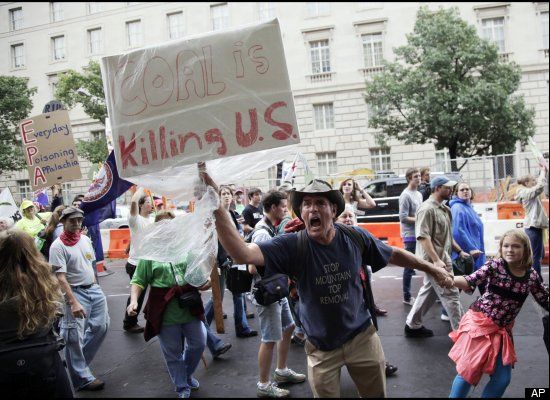 What do coal mining and tax cuts for the wealthy have in common? Both are economic injustices that favor the wealthy, burden low-income people, and add to the imbalance of our economy.
Last week, nearly 2,000 protesters traveled from Appalachia to Washington, D.C. to demand an end to the mountaintop removal, including Kentuckians for the Commonwealth (KFTC), a member of UFE’s Tax Fairness Organizing Collaborative.
For years, state and federal policies have allowed wealthy coal companies to use explosives to remove the tops of mountains to extract coal. In Appalachia, wealthy coal companies are literally moving mountains to access the precious resources beneath them, leaving life-long residents of the surrounding communities with barren fields and dried up streams.
In response to these unjust practices, citizens of the Appalachian region descended upon Washington, D.C. to demand an end to the harmful mountaintop removal practices that are irreversibly destructing their natural resources. Although the protest was peaceful -- a celebration of Appalachian culture and natural resources -- over 100 protesters were arrested in front of the White House for civil disobedience.
Mountaintop removal is an all-too-common example of how, when a low-income community and a wealthy corporation go head-to-head, the corporation with the biggest bank account wins almost every time. Just as our tax policies have been designed to favor the wealthy, our environmental policies are too often crafted with little concern for the well being of low-income communities.
Does this sound eerily familiar to the slash-and-burn approach of our big banks?
Our economic and environmental issues cannot be dealt with in a vacuum. Creating a fair economy means taking a holistic approach to designing policies that allow all people to flourish, despite the size of their bank account. This means being able to make ends meet and trusting that the natural beauty of ones’ local environment will not be destroyed in the name of short-sighted corporate greed.
Just as mountaintop removal causes devastation to our natural resources, an imbalanced economy means our that our schools suffer, local infrastructures crumble, and the middle class struggles while the wealthy minority sit atop bloated bank accounts. Like the people of Appalachia, we must feel empowered to demand better from our policymakers.
This Letter Won't Write Itself: The Estate Tax
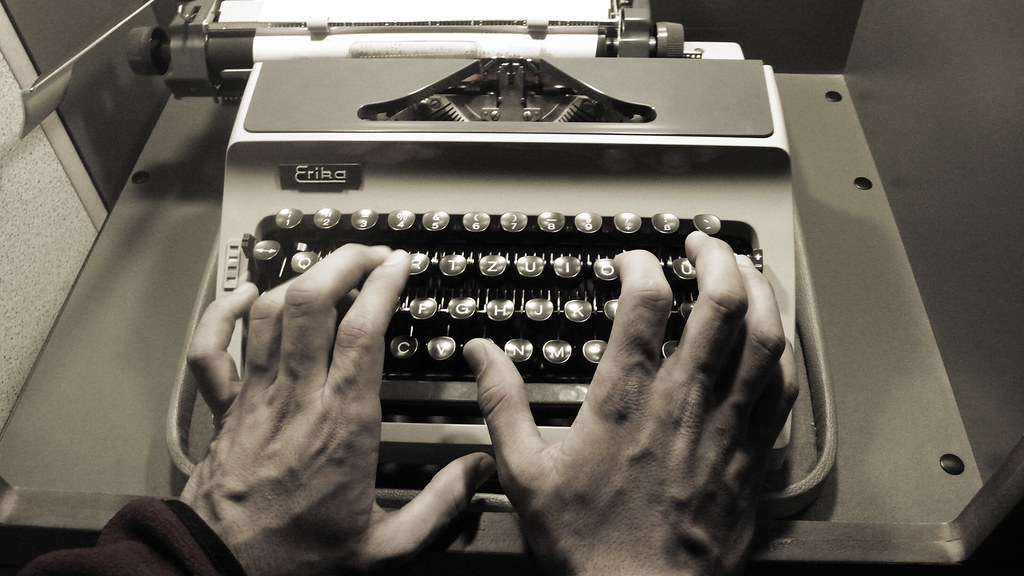
As the battle in Congress over the estate tax heats up, it is critical to make your voice heard. The estate tax doesn’t just impact wealthy billionaires. Policies that favor the rich affect everyone.
That's right -- if you rely on your paycheck each month to make rent, you have a stake in the estate tax.
Over the past decade, we have seen a massive transfer of wealth from hard-working middle class people to the rich. Today, the richest one percent of Americans own a whopping 36 percent of the wealth in this country. That’s more than the combined wealth of the bottom 90 percent of American households.
Our economy is no accident; it’s not like a hurricane or tornado that just occurs naturally. Our economy is the direct result of deliberate policy decisions made in favor of the rich and at the expense of the middle class. And if you think that’s unfair, it’s time to make your voice heard.
So get mad, grab a computer, and start writing! Compose a letter to the editor to tell your neighbors, friends, and community why a strong estate tax is both a common sense solution for addressing our nation’s budget woes and a critical part of a fair and equitable tax system.
Here are a few talking points, phrases, and tips to help you write a zinger of a letter.
First, a few need-to-know points about the estate tax:
-
It only
affects those who can afford it
In 2009, you only had to pay the estate tax if your individual estate was more than $3.5 million or $7 million for a couple. Only 1 in 500 estates were expected to pay the tax in 2009 (that’s just 5,500 per year). This overwhelmingly does not include family farms and small businesses (only 110 each year in the entire nation would qualify).
-
It
encourages charitable donations
Getting rid of the estate tax would devastate our non-profit sector by removing the tax incentive to give. Experts predict that charitable donations would decrease between 23 and 40 percent.
-
We can’t
afford NOT to tax millionaires and billionaires
Talk about irresponsible financial management -- permanent repeal of the estate tax would cost over $1 trillion dollars in the first decade, which includes lost revenue and interest payments on our ballooning national debt.
Second, a few phrases to help you drive the point home:
- Millionaires and billionaires should be giving to charity, not getting it.
- We should be making a down payment on our national debt rather than taxing our children to create tax giveaways for the wealthy.
- Politicians who think the rich aren’t rich enough have been spending too much time with lobbyists, bankers, and CEOs – or getting too much campaign money from them.
- More economic demand is what creates jobs, not tax breaks. More tax breaks for dead multi-millionaires do not create jobs.
Finally, a few writing tips:
- KISS your letters (keep it simple, stupid). A concise, clear letter is easier for your readers to comprehend. Crank it out and send it off.
- Refer to something specific that was printed in the paper the past few days. Explain why you agree or disagree with the writer.
- Give your letter a local flavor by including how many estates in your state paid the tax. Find out here (pdf).
- Tell your story; make it personal. How do tax cuts for the wealthy like the estate tax impact your life?
Once you’re done, zip it off to your local paper (you can find the email here) and email it to United for a Fair Economy at [email protected]. And then keep the pressure on. After all, tax policies won’t change themselves.
Image by c. cich on Flickr.
History in the Making: One Nation March on Washington
 This October, tens of thousands of Americans will gather at the Lincoln Memorial in Washington, DC for a mass expression of solidarity for the progressive social change all of our communities desperately need.
One Nation Working Together is a call for people from all walks of life to march as one – to put our workforce back in good jobs, for quality and affordable education and healthcare, and for equality of opportunity for all.
Now that Glenn Beck's disgusting misappropriation of the anniversary of the March on Washington, led by Martin Luther King, Jr., has come and gone, it's our turn.
On Saturday, October 2, 2010, Beck's message of fear and hate, and gimmicks posing for real solutions will be replaced by a collective voice for the common good.
We hope you will participate in this inspiring and historic event!
Click here for details and transportation options for the One Nation march.
If you'd like to march alongside other UFE supporters, please contact Kathy Lique at [email protected] for details on where to meet in advance of the march.
Robert Frank Blogs in WSJ about Responsible Wealth and Taxes
‘Tax Me More’ Says Wealthy Entrepreneur
By Robert Frank - WSJ Blog - Sept. 20, 2010
As Congress and President Obama fight over the Bush tax cuts, a small number of left-leaning rich people have come out in support of paying higher taxes. The most famous are the members of the Responsible Wealth Project, who say they pay too little in taxes and want to address inequality.
They may be an eccentric minority, or (in the view of conservatives) a lunatic fringe. But a Quinnipiac University poll this year showed nearly two-thirds of those with household incomes of more than $250,000 a year support raising their own taxes to reduce the federal deficit.
So not all of the wealthy are angry about tax hikes. But that doesn’t mean they just want bigger government. What they want is better government – and investment in growth.
An op-ed piece in the Los Angeles Times by Garrett Gruener, an entrepreneur and venture capitalist, makes two important points about taxing the rich. (Mr. Gruener founded Ask.com and is the CEO of Nanomix and is a co-founder of Alta Partners, so he’s got street cred.)
First, he says tax rates don’t make or break the success of an entrepreneur – or the jobs he creates. He says he’s paying the lowest rates of his working life. But “if you want the simple, honest truth, from my perspective as an entrepreneur, the fluctuation didn’t affect what I did with my money. None of my investments has ever been motivated by the rate at which I would have to pay personal income tax,” Mr. Gruener writes.
History, he says, shows that “modest changes in the tax rate for wealthy taxpayers don’t make much of a difference if the goal is to build new companies, drive technological development and stimulate new industries.”
Second, an economy built only on the rich – who account for the lion’s share of income and spending – is unsustainable.
“What American businesspeople know, and have known since Henry Ford insisted that his employees be able to afford to buy the cars they made, is that a thriving economy doesn’t just need investors; it needs people who can buy the goods and services businesses create.”
He says the tax hikes for the rich should be invested by government in infrastructure and research. Preserving his tax rates won’t lead him to start new companies in the U.S.
“What will change my investment decisions is if I see an economy doing better, one in which there is demand for the goods and services my investments produce. I am far more likely to invest if I see a country laying the foundation for future growth.”
Do you think entrepreneurs make their start-up decisions based on tax rates?
Read Robert Frank's blog on the Wall Street Journal and post your own comments.
Abigail Disney Calls for Strong Estate Tax in NPR Story
Showdown Over Bush Cuts Revives Estate Tax Fight
Excerpt of original report by Yuki Noguchi, National Public Radio - September 11, 2010
Click here to view the full story and listen to the original audio on NPR.
The estate tax typically hits a tiny fraction of the wealthiest Americans, but it often generates debate among a much larger segment of the population. And this year could be no exception, though it's the first and probably only year there are no federal estate taxes on the books.
That means a potentially huge windfall for the heirs to the George Steinbrenner estate, reportedly worth more than $1 billion. If Congress does not try to collect a retroactive estate tax this year, it means his heirs won't have to pay the 45 percent tax on everything over $3.5 million that would have applied last year.
This quirk in the tax code is the result of the Bush tax cuts, which started phasing out estate taxes a decade ago. Next year, if Congress does nothing, the taxes will go back up to their pre-2001 levels.
The Estate Tax
Under President George W. Bush, Congress gradually increased the amount exempted from the estate tax and reduced the top estate tax rate. The estate tax was repealed for 2010 but is scheduled to reset at pre-2001 levels.
And that has reignited debate over whether — or how big — estate taxes should be.
Estate taxes affect a small segment of the wealthiest Americans. Last year, only a quarter of a percent of those who died paid any.
Abigail Disney benefited greatly from a big inheritance but believes the estate tax should come back, at least to their levels last year.
"I take this position because I love my country," says Disney, the granddaughter of Roy Disney, who helped build the Walt Disney Co. empire. "And the fact is, my grandfather could never have built his business anywhere else."
Disney, a filmmaker and philanthropist, spent a lot of time shooting a film in Liberia. She says there, unlike the United States, there are no safe roads or schools and therefore no safe investments. And she says those who make money in a secure society like the U.S. also owe the society a debt.
She joined a group of wealthy individuals called United for a Fair Economy in part, she says, because she felt wealth is fundamentally unfair.
"It's absolutely an accident of my birth. And that's sort of the point — that there shouldn't be dynasties built around the simple good luck of being born related to somebody very wealthy," she says.
Warren Buffett and Robert Rubin are also members of the group and share the same philosophy. But not even Disney's family agrees with her. And she and her sympathizers face a mountain of money lobbying on the other side, including from the Chamber of Commerce and the National Federation of Independent Businesses.
Without any estate tax, Williams says, charitable giving could fall by up to a third...
Click here to view the full story and listen to the original audio on NPR.
Take Action to End the Bush Tax Cuts - Send a Letter to the Editor

- Congress should extend the tax cuts for working and middle class families, and not hold them hostage to tax cuts for the wealthiest 2%.
- Households in the top 5% received almost half of the Bush tax cuts since 2001 – a total of about $980 billion.
- Congress should end the tax cuts for households in the top 2%. If your household income is over $250,000 ($200,000 for an individual), include the fact that your income is in the top 2%.
- Returning the top tax rates to pre-Bush levels (36% and 39.6%) for just the top 2% would result in $690 billion in much-needed revenue over the next 10 years ($830 billion counting interest on the debt), and would generate $80 billion in just the next two years alone.
- People in the top 2% are not likely to spend their tax savings, so extending the cuts would not result in significant job growth or benefit to the economy. Again, if you are in the top 2%, please include that fact.
- It is a myth that small businesses would bear the brunt – only 3% of small businesses would be affected at all, and many of those 3% are law firm partners, real estate partners, or hedge fund managers, not really small businesses.
- If you are a small business owner, please state that, as a small business owner, I resent being used as a poster child for a cause that would not benefit me and I do not support.
- Keep it short and sweet; make it personal to your knowledge and experience, crank it out and send it off; send us a copy if you can.
- Most papers have an email address where you can submit your letter.
- Letters should refer to something specific that was printed in that paper in the past few days - there have been many stories in the news recently about President Obama's position on the Bush tax cuts and on Congressional wavering.
Bush Tax Cuts: What We're Up Against
Letting the portion of the Bush tax cuts that benefit the top tax brackets expire was a key part of candidate Obama's platform in the 2008 Presidential election. It was one of the key differences between his proposals and the proposals of John McCain.
President Obama has been in office for more than a year and a half, and the time has come for Congress to act on his signature tax proposal. But now, a powerful lobbying campaign is underway to sway the debate and hand out new tax breaks to top earners.
The same leaders that pushed through the Bush tax cuts - with their lopsided benefits for the rich - in the first place are mobilizing the same people to make the same arguments now to keep them in place. They were wrong ten years ago when the first of the Bush tax cuts was passed. Our disastrous economy proves that. And they are wrong now.
They have a powerful lobby and plenty of funding, but we're here organizing to make sure that candidate Obama's pledge is upheld. The Bush tax cuts for the wealthy have been draining our economy for ten years too long already. It's time to end them now.
OP-ED: Bring Back the Estate Tax NOW!
Bring Back the Estate Tax Now
By Robert Rubin & Julian Robertson
Column featured in The Wall Street Journal on September 1, 2010

 With a host of other issues behind it, Congress is
finally turning its attention to the expiring 2001 and 2003 tax cuts.
But there is one tax issue that should have long since been addressed:
the federal estate tax. That tax expired at the end of last year, and
there have been no estate taxes levied this year. If a new estate tax is
not enacted as soon as Congress returns from its August recess, this
void will continue until the end of the year.
With a host of other issues behind it, Congress is
finally turning its attention to the expiring 2001 and 2003 tax cuts.
But there is one tax issue that should have long since been addressed:
the federal estate tax. That tax expired at the end of last year, and
there have been no estate taxes levied this year. If a new estate tax is
not enacted as soon as Congress returns from its August recess, this
void will continue until the end of the year.
We would recommend continuing 2009's regime, with a top rate of 45% and a $3.5 million individual exemption. Small businesses and family farms can be protected both through the exemption (which is $7 million for a couple) and through special deferred payment rules.
We both believe that the estate tax should be a component of any federal tax system. Our government is always going to collect and rely on tax revenues to pay for the activities that our citizens want and need government to perform. A key criterion in choosing taxes is to have the least negative impact on economic activity. The estate tax, in our opinion, meets that test.
An estate tax can provide revenue—with little, if any, adverse supply-side economic impact—to fund deficit reduction, additional public investment or added assistance to those affected by the economic crisis. Used for public investment that has a rapid spend out, or applied to assistance for economically displaced citizens, the net effect will be to increase demand. That's because roughly 100% of the funds would be spent, while part of any large inheritance is highly likely to be used for savings or debt repayment. And either deficit reduction or public investment will better position our country for future economic success.
We also share the view that the estate tax is grounded in powerful philosophical underpinnings. Our nation views itself as a meritocracy and a land of opportunity and we have a proud legacy of upward mobility. An estate tax helps us promote this legacy, by avoiding the accumulation of inherited economic—and political—power that is antithetical to this historical vision of our society and to the vitality and dynamism that has contributed so much to our success.
Failure to restore a permanent and strong estate tax for this year has already cost billions of dollars in federal revenue. But there is still time for Congress to take action for the current year. By acting immediately, Congress can, at a minimum, solve the revenue problem the lapse has created for the remainder of the year. It could also consider going further by making the change apply from the beginning of this year.
Ordinarily in tax matters, the effective date would not precede the date of enactment, or at least the date that a measure was introduced, because Congress knows that taxpayers make their plans based on the existing code. But in the case of the estate tax, presumably nobody's demise was affected in timing by the structuring of our tax laws. And importantly there has been notice—through the president's budget and statements by public officials—that a tax would be enacted earlier this year that would apply to the whole of this year.
The question of how to address the income and other tax cuts that expire this year is already eliciting many conflicting views. But action on the estate tax should not wait. Our country is losing revenue that, with its stressed fiscal conditions, it can ill afford to forego.
Mr. Rubin is co-chairman of the Council on Foreign Relations and former secretary of the U.S. Treasury. Mr. Robertson is chairman of Tiger Management LLC.
OP-ED: Mickey Mouse, the Estate Tax and Me
Mickey Mouse, the Estate Tax and Me
By Abigail Disney
Column featured in USA Today on August 31, 2010
 Once upon a time there was a cartoon character created by an inventive man named Walt Disney,
my great uncle. Plucky, irascible and spirited, this character
delighted families across the country and was the first in a long line
of successes for the company Walt started with my grandfather, Roy O.
Disney.
Once upon a time there was a cartoon character created by an inventive man named Walt Disney,
my great uncle. Plucky, irascible and spirited, this character
delighted families across the country and was the first in a long line
of successes for the company Walt started with my grandfather, Roy O.
Disney.But the character's name might surprise you: Oswald the Lucky Rabbit. The Disney brothers' first success wasn't all that lucky for the company. The cartoon's distributor wrested the rights to Oswald away from Walt and Roy almost as soon as he had become popular. This loss was a huge setback for both men, and my grandfather vowed never to let himself be taken advantage of again. He soon registered a copyright on a new character named Mickey Mouse. It was 1928, and it was neither the first nor the last time the Walt Disney Co. benefited from a federal system of protections, laws and taxes that created fertile ground for building a business empire.
In addition to the copyright protections for Mickey, the Federal Communications Commission regulated the airwaves that carried the Disneyland television series and, of course, the Mickey Mouse Club. The transportation and federal highway system built in the wake of World War II took millions of visitors to Disneyland. The Marshall Plan helped rebuild devastated European markets into which Disney poured its products, turning a quaint American company into a global brand.
Taxes are on everyone's mind lately for good reason. Not only will Congress have to make some tough decisions about the Bush tax cuts soon, but if lawmakers do nothing, the estate tax will automatically be reinstated after a year's hiatus — in its 2001 form. A great deal of misinformation is flying around out there about this, but most agree that the tax is flawed and needs to be modified.
One thing I do know is this: In a far stricter tax environment, my grandfather still managed to accumulate and pass on ample funds to make three subsequent generations very comfortable indeed. And as an inheritor I am here to tell you, the estate tax is not as much of a bogeyman as you've been led to believe.
The truth in numbers
Let's start with the facts:
• First, the estate tax is not a double tax. Have you met a multimillionaire who earned that much money pulling down a weekly paycheck? People who make enough to be affected by the estate tax — fewer than 1% of Americans who die in any given year — amass their fortunes by investing. Investment income is taxed differently from earned income, often not at all until it's sold. People like me, who inherit assets such as Disney stock, can spend our lives watching those assets grow, and when we pass them along to our children, they have not been touched or diminished at all by the tax system. The only thing I have paid taxes on is the interest from these assets, not their increased value.
• Second, opponents of the estate tax claim family farms will have to be broken up to pay the tax, but good luck finding an example of this. Further, if the exemption is kept at $3.5 million (where it stood last year) and indexed for inflation, the likelihood of this ever happening is reduced to nil.
• Third, the estate tax incentivizes people like me to do good with our wealth because there is no estate tax on donations to charity. My filmmaking and foundations rely on a tax code that supports a vigorous non-profit sector, a vital part of our society that is bigger and stronger because of the many millions of dollars that flow into it as a result of the estate tax and other tax provisions.
To those who believe the estate tax is unfair, I say that there is no tax more fair than this one. I recently signed the Call to Preserve the Estate Tax organized by United for a Fair Economy because the estate tax is an expression of our deepest American values: that we live in a meritocracy, not an aristocracy; that every generation is a fresh start; and that we choose to build a society in which wealth and opportunity do not accrue to people simply for being born wealthy.
Walt and Roy embody those values: They started without two cents to rub together and made a million wishes come true.
I have seen the business environment in Liberia, for example, a country with no tax revenues. I suspect even my brilliant grandfather would not have been able to build a successful business there. I have been to places like Sudan and Congo and know what it looks like when there is no 911 to call, no schools and where governments are disinterested in working toward the collective good.
The cornerstone
Here at home, I have watched the gap between rich and poor driven to historic highs by a tax policy that has exacerbated our deficit and eviscerated our basic capacity to provide schooling, emergency services, and clean water and air for one and all. The estate tax is the cornerstone of a progressive system that leaves wealthy heirs with ample funds while providing the government with the resources it needs to build an environment for the common good. By preserving it, we not only restore billions in revenue to the national treasury — we also restore our most cherished collective ideals as a nation.
"Tax me" may be the least popular sentence in America, but it's what I am asking, and I hope that our leaders are listening.
Abigail Disney is a filmmaker and philanthropist. Her series Women, War & Peace will air on PBS Wide Angle in 2011.
The Bush Tax Cuts: Everyone's Chiming In!
As year-end approaches, the debate over the expiring Bush tax cuts is getting messy and harder to tolerate. Part of the reason is that there are more than just the usual suspects trying to advance clearly terrible proposals.
Sarabeth Guthberg at 1115.org had me squinting at her blistering critique of claims made by political advisor/economist Mark Zandi. (He had it coming.) As a key advisor to House Speaker Pelosi, Zandi is trying to rally support for permanent extension of the Bush tax cuts benefiting the "middle class," and a one-year-but-not-really extension of the tax breaks for those earning more than $250,000 per year (roughly the top 2%). He says it's necessary because the recovery is still too fragile, and that even the richest Americans "may be sensitive." (And, we wouldn't wanna make anyone cry, right?)
Experts from different sides of the board, including Paul Krugman and Alan Greenspan, have sounded off, saying the Republican proposal to permanently extend all of the Bush tax cuts is a bad idea. The tab for such a move would run up to around $3.7 trillion over 10 years.
Guthberg summed up the costs of 10-year extension of the Bush tax cuts benefiting those being defined as "wealthy," and those defined as "middle-class" by the Obama administration:
"For the first 98% of Americans, extending the tax cuts for 10 years will cost $3 trillion. By a rough calculation, that’s $2,500 each year per taxpayer.
For the next 1.9% of Americans, extending the tax cuts for 10 years will cost $320 billion. By a rough calculation, that’s $14,000 each year per taxpayer.
For the last 0.1% of Americans, extending the tax cuts for 10 years will cost $360 billion. By a rough calculation, that’s $300,000 each year per taxpayer."
And, the Washington Post put together a nifty bubble chart to show us what the 10-year per taxpayer costs would look like across income levels.
In spite of the massive price tag on the Obama proposal to extend tax cuts for the first 98% of earners, the overall economic impact would be stimulative, as low- and middle-income people will continue to create demand for goods and services. The $680 billion it would cost to extend the tax cuts for the top 2% would unnecessarily contribute to the GOP's precious deficit and further shift the costs of public services onto said middle class, which would be particularly tough on middle to low-income families.
The passage of President Obama's proposal on the Bush tax cuts would be a small, but positive step. It's not our endgame, but we can still use the momentum of a modest victory to press forward for greater tax fairness.
Looking for a laugh? Watch Stephen Colbert's commentary on the Bush tax cuts.

Chart h/t Washington Post
| The Colbert Report | Mon - Thurs 11:30pm / 10:30c | |||
| The Word - Ownership Society | ||||
|
||||
Lapham Speaks...on NPR's "Here & Now"
 In case you didn't catch this last week, Robin Young of NPR's "Here & Now" interviewed Mike Lapham, Director of UFE's Responsible Wealth project.
Congressional Elitism Shines Through in Effort to Save Public Jobs
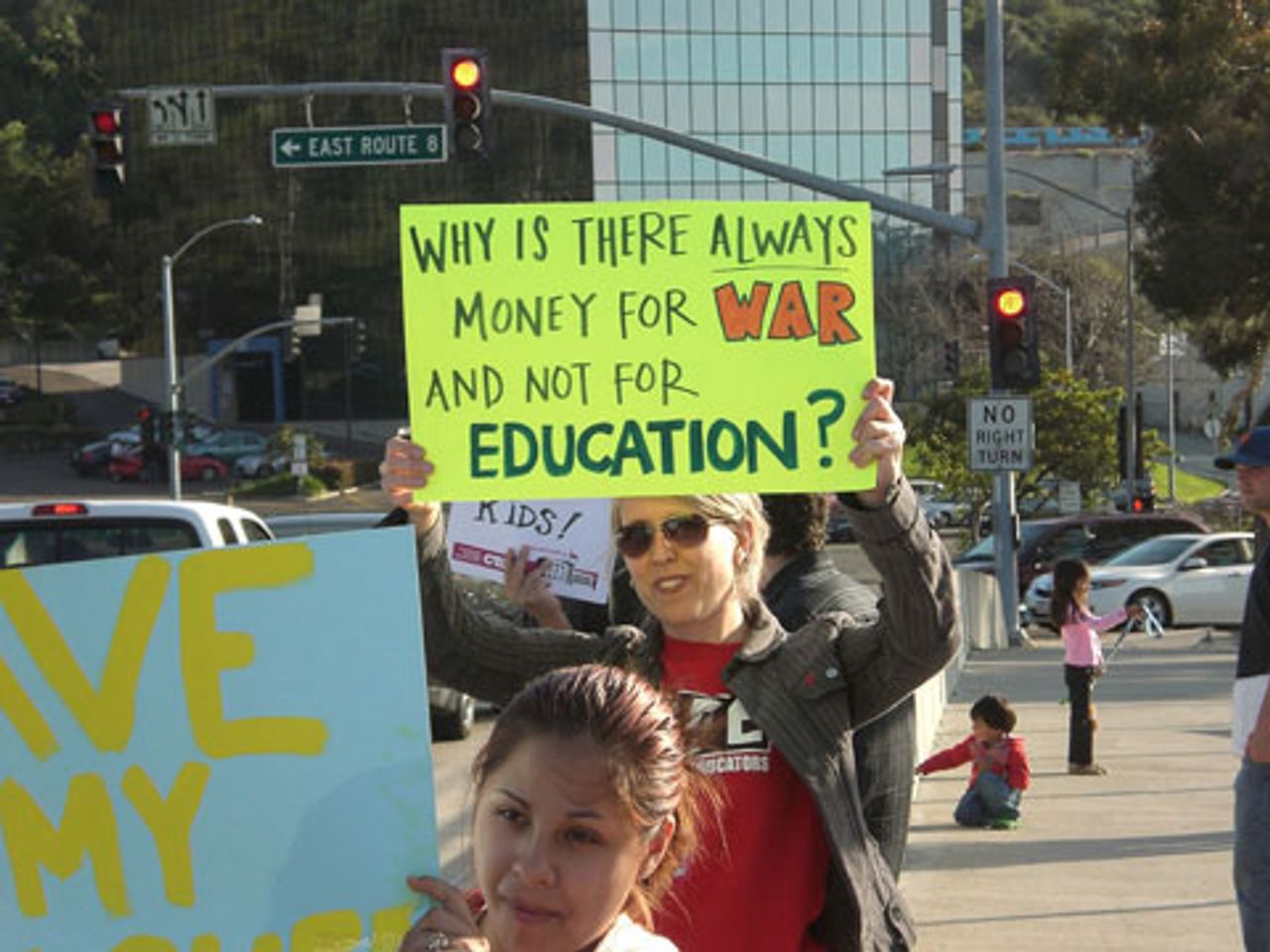
Photo h/t wsws.org
This August, President Obama signed into law a bill that would save more than 300,000 jobs in teaching and public service. Amidst this Great Recession, that seems like a no-brainer, but it turned out to be one of the more controversial bills of the summer. Republican demands that the bill be deficit-neutral led to the shifting of $26 billion (half the House's intended allocation) away from food stamp and green jobs program to fund the initiative.
This resulted in an outpouring of negative media coverage: public employees called “fat cats” and federal aid to states labeled “another sloth-encouraging bailout." One headline even likened this effort to preserve teaching jobs to theft: “Robbing Renewable Energy to Pay Teachers.”
All this haggling was over $26 billion. $26 BILLION! That's, by any standard, a sizable amount. But, compared to the nearly $137 billion Congress has allocated to the largely unpopular Iraq and Afghan wars in this fiscal year, or the $680 billion it could cost to extend the Bush tax cuts for the top 2% of households over the next decade, it's peanuts.
With unemployment at 9.5%, foreclosure afflicting a projected 1 million households this year, almost one in eight Americans receiving food stamps, and still-soaring healthcare costs, one might wonder why our budget isn't sufficient enough to address these issues. Approximately 58% of the 2010 discretionary federal budget is sucked up by defense, and a multitude of other very important programs end up being treated like parking meters – funded with what pocket change remains. It's no news flash that there's plenty of waste that needs to be cut out of the defense budget.
It is absolutely absurd that our elected leadership would buckle to Republican demands for deficit-neutrality in funding public services and clean energy development. Neither the ongoing Iraq and Afghan wars, nor the $2.5 trillion Bush tax cuts of the past decade were paid for up front. The Center on Budget and Policy Priorities (CBPP) names both of the above, if continued, as two primary drivers of the coming decade's deficit. A June CBPP report explains:
"Together with the economic downturn, the Bush tax cuts and the wars in Afghanistan and Iraq explain virtually the entire deficit over the next ten years.
The deficit for fiscal year 2009 was $1.4 trillion and, at nearly 10 percent of Gross Domestic Product (GDP), was the largest deficit relative to the size of the economy since the end of World War II. If current policies are continued without changes, deficits will likely approach those figures in 2010 and remain near $1 trillion a year for the next decade."
So, when the GOP calls for paygo on public education, safety and health, this is what that translates to: Trillions of dollars for senseless wars and tax breaks for the wealthy? ABSOLUTELY! The well being of the American majority? Come on people, turn your pockets out.
It's high time our federal spending priorities be reassessed, and it's got to start with one simple question: Are we helping those who need help? The way Congress is currently doing things gives the impression that they're not only blind to the escalating strains that the recession is having on people, but also the devastation their big business alliances are wreaking on the planet.
OP-ED: How the Estate Tax Benefits Small Businesses

How the Estate Tax Benefits Small Businesses
Don't let opponents of the estate tax frighten you.
Small business owners like me have for too long served as poster children for a misleading campaign led by the super wealthy to weaken or abolish the estate tax. I'm the proud owner of Maine's Borealis Breads, and I want to make something crystal clear: The estate tax impacts neither me nor the vast majority of small business owners. In fact, I support a stronger estate tax.
In 2009, a married couple could leave $7 million tax-free to their heirs. Most small business owners' annual incomes are too little to accumulate enough wealth to pay the estate tax. In 2009, individuals earning less than $82,000 declared 95 percent of all small business income, according to the Congressional Research Service. It should then be no surprise that the nonpartisan Tax Policy Center estimates that fewer than 100 American small business or farm estates were expected to pay the estate tax in 2009.
 A
provision in the tax cuts passed under President George W. Bush made
2010 the first year since 1916 that estate taxes were not levied,
resulting in the loss of billions of dollars in federal revenue. For
generations, even with the estate tax in effect, families have been able
to pass their small businesses and farms onto their descendents. These
same generations of small family businesses have enjoyed and benefited
from the unprecedented opportunities found in America.
A
provision in the tax cuts passed under President George W. Bush made
2010 the first year since 1916 that estate taxes were not levied,
resulting in the loss of billions of dollars in federal revenue. For
generations, even with the estate tax in effect, families have been able
to pass their small businesses and farms onto their descendents. These
same generations of small family businesses have enjoyed and benefited
from the unprecedented opportunities found in America.
So if the estate tax has no real impact on an overwhelming majority of small businesses, why then do its opponents so adamantly assert that it does? I believe the answer to that question is that opponents are trying desperately to convince average Americans that they'll be affected by the estate tax. In reality, the estate tax is deliberately designed to affect only society's wealthiest households. [...]
Read the full op-ed by Jim Amaral on OtherWords.org
Nation Under a Microscope: Pain & Hope at the Local Level
Nation Under a Microscope: Pain & Hope at the Local Level
By Antionetta Kelly, UFE Intern via the Hampshire College Civil Liberties and Public Policy program
Working as an intern at United for a Fair Economy (UFE) has helped me realize that taxes, economic policy and government play vital roles in improving our communities. UFE warns against and strives to dilute concentrated wealth and power. They work on a national scale to promote progressive economic policies that can enable all levels of government to invest in the common good, and support a grassroots economic justice movement that can bring those policies to fruition.
 When we zoom in to
see what's happening at the local level, in too many areas we're
finding that community development remains stagnant, including in
our own, Boston. Here, local decision-makers continue to place the interests of monied special interests above the needs of most residents – especially those in underdeveloped neighborhoods. Here's a snapshot of what we've been dealing with:
When we zoom in to
see what's happening at the local level, in too many areas we're
finding that community development remains stagnant, including in
our own, Boston. Here, local decision-makers continue to place the interests of monied special interests above the needs of most residents – especially those in underdeveloped neighborhoods. Here's a snapshot of what we've been dealing with:
In 2009 – despite revenue growth in several tax categories – local officials contended that Boston was in an economic crisis, yet responded with tax breaks for large corporations and threats to lay off hundreds of teachers, public safety and other city workers.
Even more disheartening, the city has forfeited opportunities to generate significant revenue through property sales. Last year, the City of Boston sold twenty-five lots at far less than their assessed values. In one instance, a property assessed at $99,400 (currently at $114,400), was sold to a city employee for only $5,000! And, in spite of this period of austerity, our local officials have approved hefty tax breaks for corporations, relinquishing tens of millions of dollars in corporate tax revenue.
Meanwhile, our communities continue to deal with unacceptable high school drop-out rates, municipal unemployment of 8.2%, and too many neighborhoods reeling from the effects of concentrated foreclosures. In spite of that, our local officials have asked us to make sacrifices regarding public services like libraries and schools because of insufficient funding. Just before his 2009 re-election campaign Mayor Thomas Menino asserted that there wasn’t enough money to fund teaching, public safety and community outreach jobs, and when union workers in these areas refused to accept his proposed wage freezes, he threatened them with hundreds of layoffs and building shutdowns. More recently, there have been proposals to close several library branches, and claims that funding isn't available to provide enough summer jobs for local teens.
Our local government could do more to extend employment opportunities to marginalized communities, or at the very least, enforce the policies that are designed to support those efforts, like the Boston Residents Jobs Policy (BRJP). The BRJP mandates that developers hire 50 percent Boston residents, 25 percent people of color and 10 percent women; however, those quotas have been consistently brushed aside.
These types of policy decisions – ones that prioritize special interests over the residential majority – undermine our city's economic well being. The social consequences can be extremely severe – increased unemployment, wider-spread foreclosures, diminished public safety, escalating crime and violence, increased community health risks, a widening racial divide, and ultimately, the creation of economic deserts. And, the longer the causes go unaddressed, the more difficult it will be to reverse the cycles of poverty.
Boston's current socioeconomic situation isn't unique. Budget deficits are an epidemic, affecting communities in every part of the US. But, there is so much our governments -- local, state and federal -- could do to alleviate the pains millions of Americans are experiencing as a result of this recession. We can no longer allow corruption or cowardice to steer our economy in the wrong direction. It's up to us and our communities to make that change.
As Justice Louis Brandeis once suggested, state legislatures are our nation's "laboratories for democracy." Well, local governments are our nation's vanguards. Both the innovations and the power of a democratic system come from the ground up, and progressive social change will only come about when communities rise up against injustice.
Dishonoring MLK's Legacy

Dishonoring MLK's Legacy
What do Beck, Palin, and the NRA have to do with the 1963 March on Washington?
"This year's anniversary of the historic 1963 March on Washington promises to be memorable.Though big commemorations aren't typical for 47th anniversaries, thousands will be in the streets on August 28 commemorating the march, including many people advancing a social agenda that would make Martin Luther King Jr. roll over in his grave.
Flamboyant talk-show host Glenn Beck has called for a national rally on the anniversary at the exact same location as the historic protest, the Lincoln Memorial. Beck's rally theme is 'Restoring Honor.' According to his website, this "celebration of America" won't be political. Well then, why have Sarah Palin scheduled to deliver the keynote speech, and why is the National Rifle Association endorsing this right-wing spectacle?
From what I can gather, these folks think that America can restore its honor by strengthening individual virtue, especially if enough people come to Washington on Aug. 28 to listen to inflammatory speeches. Or pick up copies of Beck's new book 'The Plan,' which he'll launch at this absurd event.
What do Beck, Palin, and the NRA have to do with the 1963 March on Washington, where Dr. Martin Luther King delivered the landmark "I Have a Dream" speech? Nothing. Beck has admitted not realizing that the legendary March occurred on Aug. 28. He credits "divine providence" for having his rally/book launch converge with such a historic event. Beck now proclaims that he is working "to finish the job" that was at the heart of King's poetic vision. [...]"
Read the full op-ed by Dedrick Muhammad on OtherWords.org
New York Tax Law Could Result in Fewer Charitable Donations

N.Y. Governor Sings Into Law Limits on Charitable Deductions
"New York Gov. David A. Paterson has signed into law a revenue bill passed by the state’s legislature that limits charitable deductions for “high earners”—a move that has nonprofits and a prominent New York philanthropist worried about a related significant loss in contributions to charity.
The law puts new limits on tax deductions for people with state-adjusted gross income above $10-million annually—about 3,500 taxpayers in New York. Those residents are now able to write off only 25 percent of their charitable contributions on their state income taxes rather than the previous 50 percent.
The provision in the budget plan runs for three years, including the current 2010 tax year.
The charitable-deduction provision could provide up to $100-million in revenue during the current fiscal year for the state, which has had a budget crisis and has sought additional funds. But nonprofit organizations and donors think the change will lead many wealthy people to give less money to charity.
'Charities have been hit from every side in the last three years, including seeing decreases in public funds,' said Abigail E. Disney, a New York philanthropist and film maker. [...]
Read the full column by Grant Williams in The Chronicle of Philanthropy.