
Responsible Wealth Members Call B.S. on Bachmann
After Warren Buffett called for the federal government to raise taxes on the super wealthy this week, Republican presidential candidate Michele Bachmann had a suggestion for the billionaire: Send any unwanted money to the U.S. Treasury.
“Mr. Buffett, write a big check today,” Bachmann said. “There’s nothing you have to wait for.”
The Minnesota congresswoman is correct. The federal government has had a law on the books for 50 years that allows anyone to open up his checkbook, write out a donation payable to the Bureau of the Public Debt, and send it to a post office box in Parkersburg, W.Va. — or make an online payment at www.pay.gov.
Through the first three quarters of the current fiscal year, Americans had donated about $2 million to the fund — compared with $2.8 million in donations for all of fiscal 2010.
That amounts to roughly one ten-thousandth of a percent— that is, 0.0001% — of the federal debt.
The money is set aside and ultimately used to pay the principal on maturing Treasury bills that are issued as debt to finance government operations, according to McKayla Braden, spokeswoman for the debt bureau.
“We send everybody a thank you,” Braden said, noting that the agency gets more donations whenever there’s a public crisis like a natural disaster or the summer deadlock than over raising the debt ceiling.
But millionaires and billionaires who, like Buffett, support higher taxes on the super-rich, say voluntary donations won’t solve the country’s debt problems. Even Buffett’s fortune of approximately $50 billion amounts to less than half a percent of the total.
“It’s better to have a policy than to just bank on individual, idiosyncratic discretion,” said Judy Pigott, a Seattle heiress to a trucking fortune. She is also a member of Patriotic Millionaires for Fiscal Strength, which advocates for raising taxes on those who earn more than $1 million a year.
“We all benefit from being part of our country ... and those of us who have abundant financial resources also have abundant privileges,” Pigott said.
Relying on voluntary donations wouldn’t bring in a reliable amount of money that could match revenue from raising taxes across the board, said Lee Farris, a tax policy coordinator for United for a Fair Economy.
A subgroup of that organization, Responsible Wealth, focuses on raising taxes on the wealthy.
“I’m sure Rep. Bachmann would probably not agree that all people who owe money to the U.S. Treasury should make voluntary contributions,” said Responsible Wealth member John Russell, a real estate developer in Portland, Ore. “There’s a fundamental issue of fairness, and nobody wants to be treated in a manner that’s different than other people.”
OP-ED: Let's 'Make Them' End the Great Recession

Did you breathe a sigh of relief when President Barack Obama signed the debt deal into law earlier this month? If not, you weren't the only one.
Raising the national debt ceiling may have forestalled an immediate U.S. default and credit collapse, but the deal will do absolutely nothing to address the real problems of our time: stubbornly high unemployment and a suffocating economy. Recovering from this Great Recession and achieving longer-term stability will
require a broad, informed, and unified movement to battle the corporate-backed powers that are waging economic war on working Americans.
While blame for this sad state of affairs falls mainly on Republican free-marketeers and the tea partiers who have incessantly pushed a cuts-only economic agenda, those players only occupy one end of a money-poisoned political spectrum that also includes most members of the Democratic Party. Obama, for his susceptibility to corporate influence and unwillingness to lead, is also responsible for American's economic doldrums.
When progressive leaders approached President Franklin D. Roosevelt in 1933 about what would become the New Deal, his response was, "Make me do it." And so it goes for today's progressive movement, whether you bought into Obama's bold campaign promises or not.
Our job as concerned citizens is hard. These days, commonsense policies, rooted in sound economic analysis, are subject to ideological criticisms that often preempt their passage. We also know that popular opinion by itself won't necessarily affect our governing course.
Take tax policy, for example. A Washington Post-ABC News poll, taken before the debt deal passed, showed that 72 percent of voters support raising taxes on high-income households to reduce the deficit. The final package, the product of a political game dominated by radical conservatives, called for nearly $2.5 trillion in spending cuts and no tax measures that would raise new revenue. One Las Vegas Sun headline for a letter to the editor aptly summed up the outcome: "GOP controls half of government, but ignores the public."
Federal revenue is at its lowest level since the 1950s. The income share of the top-earning 1 percent of Americans has reached heights unseen since 1928, just before the Great Depression. Despite these phenomenal gains, this elite group continues to enjoy historically low federal taxes. Between rates, deductions, and loopholes, they often pay lower effective rates than many middle-class families. As such, it should come as no surprise that the richest 1 percent of Americans now controls nearly as much wealth as the bottom 95 percent of the country combined.
Our circumstances are the result of decades of reforms that shifted taxes off the wealthy onto the middle-class under the pretense of "trickle-down" economics. That strategy has proven ineffective and needs to be reversed. Yet, conservative officials gnash their teeth and threaten the global economy at the mere mention of correcting those policy mistakes.
We can no longer allow a hopelessly unreasonable minority in a severely corrupted system to dictate the terms of our economy. MSNBC's Dylan Ratigan has asserted that Obama should abandon our "bought Congress" and begin a dialogue with voters to restore democracy and repair the economy.
Clearly, we can't sit and wait for Obama to knock on our doors to chat. Our elected leadership will do what it will for as long as we allow it. Indeed, we can't "make them" fix the economy by asking them to do it. We can only get it to happen by organizing, educating, and mobilizing people from all walks of life to fight for justice in all places where it does not exist, from our nation's capital to our own neighborhoods.
This op-ed by UFE's Mazher Ali was originally published and distributed by OtherWords.org on August 22, 2011.
What You Probably Have in Common with Matt Damon
Matt Damon might be a super-rich movie stud, but it appears we've got plenty in common when it comes to taxes. This summer, Damon attended a "Save Our Schools" rally in D.C. to show solidarity with public school teachers and to demand an end to the conservative political crusade against them. To our delight, he also took a moment to share his views on taxes and the wealthy. Here are a few of his comments.
- On the debt ceiling debate: "I'm so disgusted."
(We were too. And, so was the majority of the country.)
- On the wealthy paying more taxes: "Yes...the wealthy are paying less than they paid...certainly in my lifetime. [...] It's criminal that so little is asked of people who are getting so much. [...] I really don't mind paying more taxes. [...] Is it that much worse if we pay 6 percent more in taxes? Give me a break. [...] Why don't you just tax the really rich, you know, guys like me?"
(Amen, brother. The alternative to new revenue is more bone-deep budget cuts. Among those who would "feel the pinch" of more budget cuts are students, seniors, the unemployed and even our service men and women. We're talking about drastic reductions to programs that, whether we realize it or not, we all benefit from in some way.)
- On education as a national priority: "I'd rather pay for taxes than cut Reading is Fundamental or Head Start or some of these programs that are really helping kids."
(Cuts to education budgets — an exercise in poor judgment and shoddy governance — have become an epidemic. No good can possibly come of them. Even Time magazine's "Curious Capitalist," Michael Sherman is calling for an alternative to the debt-driven growth model of recent decades. He calls for, among other things, "massive investments in education and job re-training to take advantage of the new world." Sherman explains, "More education will prepare more people to work in new industries, or to invent new industries of their own.")
Damon's comments on education and the economy have made him a lightning rod for media attention and, thus, an important awareness-raising figure. The work of the progressive movement isn't getting any easier, so we're thankful for all the help we can get. Like many others, we're glad to have his support.
"Tax Us? Go for it," say these rich people
As a phenomenally wealthy individual, Warren Buffett feels "coddled" by the U.S. government, which has for decades asked him to pay less and less into public coffers. His recent New York Times op-ed was a brazen call for Congress to raise taxes on richest people in the U.S.
While the poor and middle class fight for us in Afghanistan, and while most Americans struggle to make ends meet, we mega-rich continue to get our extraordinary tax breaks. [...]
These and other blessings are showered upon us by legislators in Washington who feel compelled to protect us, much as if we were spotted owls or some other endangered species. [...]
Last year my federal tax bill...was only 17.4 percent of my taxable income — and that’s actually a lower percentage than was paid by any of the other 20 people in our office.
Buffett's effective federal tax rate isn't just lower than the other 20 folks in his office, it's actually lower than many middle class families' tabs. He wants new revenues to come from the rich, not the poor and the middle class, who he feels "need every break they can get."

Buffett's not-so-wild sentiment received due support from members of UFE's Responsible Wealth project (RW). Former Wall Streeter and RW member, Edith Everett, echoed Buffett in a column on AMNY.com, recognizing that the wealthy, like herself, didn't become so by themselves.
People who are just scrimping and saving to pay their rent, they shouldn't pay one penny more. Rich people make their money on the backs of the workers.
RW director Mike Lapham and businessman/RW member Jim Mann were invited onto SoCal public radio to combat baseless arguments from the economics naysayers of Americans for Tax Reform (ATR). The pair added yet more legs to the Buffett argument, Mann noting that historically high economic inequality must be strongly considered as we move forward.
It's in my self interest — and that of just about everybody in America — not to live in a place where economic and wealth disparity continues to grow the way it has over the last twenty years. The idea of having a democratic system is pretty unsustainable where 1 percent of the population has that enormous 20 or 40 percent of the wealth. [...] That leads to political instability. I'm happy to pay higher taxes, because I know it's somehow morally the right thing to do, which it is. I also think that on a practical level it's the right thing to do, so that my kids and my grandkids continue to live in a country that has a stable political and economic system.
ATR representative Mattie Corrao made a particularly foolish and tissue-thin assertion that people like Buffett should simply volunteer to pay more taxes. Lapham made prompt waste of Corrao's flimsy talking point.
Corrao: Warren Buffett himself is welcome to pay more taxes if he feels that this is a tax issue...If he truly felt that that was the issue, he could certainly write the treasury a check.
Lapham: It's crazy that effective tax rates go down as income goes up. The wealthiest in this country are paying a far lower percentage than most everyone else [...] It's just sort of a juvenile response to say that we should just send in a check voluntarily. We can't voluntarily stop at stop signs or pave our own roads or test our own water.
I'll add that every dollar of additional revenue is a dollar less that would otherwise be slashed from Medicare, Social Security, education, research, infrastructure or any other of a host programs that this country so desperately needs. New revenue can also make possible a jobs program, which, for no good reason, continues to elude Congress and the Obama Administration. And, the only rational way to generate new revenue is to demand shared sacrifice from the wealthy and corporations.
The alternative is a pillow to the face of the economy — more budget cuts, more jobs lost and more devastation to struggling families. The result will be either another painful dip in the ongoing recession or a full-blown depression.
If you agree with Warren Buffett and Responsible Wealth, sign MoveOn's online petition — they're trying to gather at least 200,000 signatures. Then, call your legislators and tell them you want new revenue and you want it to come from raising taxes on the wealthy and corporations.
RW Member Shows Support for Buffett on SoCal Radio
RW director Mike Lapham and businessman/RW member Jim Mann were invited onto SoCal public radio to combat baseless arguments from the economics naysayers of Americans for Tax Reform (ATR). The pair added yet more legs to the Buffett argument for higher taxes on the wealthy. Mann also noted that historically high economic inequality must be strongly considered as we move forward.
Listen here:
Rebuilding the Dream with Fair Taxes

The following is a tax fact sheet, authored by United for a Fair Economy, for the Rebuild the Dream coalition, led by MoveOn.org in partnership with more than 80 organizations and over 160,000 individuals committed to advancing one simple ideal: liberty and justice for all. The coalition has worked together to develop the "Contract for the American Dream," which includes 10 critical steps for getting the economy back on track. This fact sheet details one of those steps.
Return to fairer tax rates
End, once and for all, the Bush-era tax giveaways for the rich, which will eventually have to be paid by the rest of us — or by our kids. Also, we must outlaw corporate tax havens and tax breaks for shipping jobs overseas. Lastly, with millionaires and billionaires taking a growing share of our country’s wealth, we should add new tax brackets for those making more than $1 million each year.
The Problem:
- We lack the revenue to pay for the vital public systems and structures that we all benefit from. The taxes we pay lay the foundation for a sound economy and wealth creation by funding roads and railways, well-educated workers, courts, clean food and water, scientific research, and much more. But federal revenue is at its lowest level since 1950, relative to the size of our economy. The Bush-era tax cuts have cost us $2.5 trillion in revenue since 2001, and have not created jobs. Our national debt grew as we borrowed money to launch two wars, while the worst recession in decades caused huge job losses that shrunk revenues.
- Tax changes over several decades have shifted taxes off the wealthy and onto the middle-class at the same time that the rich have gotten much, much richer. The amount of income going to the top 1% more than doubled from 10 percent in 1979 to 24 percent in 2007. Today, the wealthiest 1% controls 35% of all wealth, while the bottom 80% has only 13 percent. The richest 400 taxpayers paid just 18% of their income in taxes in 2008, down from 30% of their income in 1995. And, shockingly, over 1,400 millionaires paid zero income tax in 2008.
- Our tax system rewards wealth over work. Income from Wall Street — capital gains (selling stocks, real estate, and other investments) and dividends (earnings from stocks) is taxed at just 15%, while income from work is taxed at a top rate of 35%. That means a secretary pays a higher tax rate than her CEO boss does on most of his income.
- Our tax system worsens the racial wealth divide. Because of historical and ongoing discrimination and segregation, in 2009, the typical White household had 20 times more wealth than Blacks and 18 times more than Latinos. Tax breaks for wealth accumulation flow overwhelmingly to Whites. Whites are 11 times more likely than Blacks and Latinos to have a net worth of $5 million or more; cutting the estate tax overwhelmingly benefits White heirs.
- Tax changes, loopholes, and havens have shifted taxes off corporations and onto the middle-class and small businesses. The share of revenue from the corporate income tax has been slashed in half over the last 60 years. Today, billion-dollar corporations like Verizon, Bank of America, Exxon, and General Electric pay zero or shamefully low taxes. Tax haven abuse ships both American jobs and tax dollars overseas.
What We Can Do About It:
- End the Bush-era income tax cuts for the highest-income 2% who earn over $250,000. In 2012, allow the top tax rate to return from 35% to 39.6%. Extending those tax cuts would cost over $800 billion over the next decade. Raising taxes on wealthy households reduces the deficit with little impact on the economic recovery or job growth. Only 3% of small business owners have such high incomes, so few would be affected by these tax increases.
- Restore tax brackets for the super-rich. The Fairness in Taxation Act, H.R.1124, would raise $74 billion in 2011 by increasing tax rates on both work and capital gains to 45% for millionaires and to 49% for billionaires. Then hedge fund managers who earn millions will no longer pay a 15% rate.
- Establish a strong estate tax. Our nation’s only tax on wealth was sharply reduced in 2010. The Responsible Estate Tax Act, S.3533, would exempt $3.5 million from taxes and add rates of 45% to 65% for the ultra-wealthy, raising about $170 billion over ten years compared to the current low estate tax. A strong estate tax reduces inherited wealth and the disparities in wealth held by Blacks and Latinos.
- Crack down on offshore tax dodging that costs taxpayers $100 billion a year. The Stop Tax Haven Abuse Act, S.1346 and H.R.1265, would combat offshore secrecy and fictional foreign entities, close tax loopholes, and strengthen penalties on tax shelter promoters.
Visit www.RebuildtheDream.com for more information and to get involved.
AUDIO: Debt Debate Not a Debate At All
UFE's Tim Sullivan joined Andrea Sears on WBAI Pacifica Radio New York to make it clear that the debt standoff in Washington, D.C. has become an exercise in political posturing and brinksmanship, rather than public service.
Sears refers to UFE's recent blog post, "7 Questions on the Debt that Politicians Don't Want Us to Ask," in which we compare various spending priorities to emphasize what Republicans' "no new taxes" approach could mean for ordinary families, and expresses confusion over the focus of the debate in Washington:
"These are things that are not being discussed in Washington. I'm just baffled by this. The country is in terrible shape right now, economically, and yet the debate in Washington is restricted to sloganeering: no new taxes, don't tax the job creators, who haven't created a job since Reagan."
Click here to listen to the interview. (Forward to 6:40 for the interview with Tim Sullivan.)
Seattle RW member Speaks Up on Debt Debate
 Tracy Lake can't believe that anyone would be willing to risk the U.S. credit rating.
TRACY LAKE: It's probably the most valued asset we have in a global economy, is the faith in credit of our ability to pay something back. And the fact that we've already purchased goods and services, and now we're deciding whether or not we're going to pay for them is just plain wrong.
KASTE: Lake is a real estate developer and she's worried that a downgrade would raise interest rates and make it harder to get the loans she needs to run her business. Like Carender, she's politically active but she's part of Responsible Wealth, an organization of well-to-do types that want to pay higher taxes.
LAKE: The only right and moral thing is to tax the wealthy, wealthier part of our population.
KASTE: Be completely honest. If you had to pay a higher tax rate, wouldn't that suppress you're productivity as a company, or your ability to employ people?
LAKE: Yes, it would. But I look at it this way: I am where I am because of opportunities afforded me because of our economic structure, because of our culture, because of the freedom and access to education. Wealthy Americans owe this due bill back to our country for the opportunity to earn great sums of money.
Listen to the story and read the full transcript on NPR.org
7 Questions on the Debt that Politicians Don't Want Us to Ask
 The U.S. government hit its $14.2 trillion national debt ceiling on May 16 and the global economy hasn’t imploded...yet. Treasury Secretary Tim Geithner took a few “extraordinary measures,” such as suspending investments in federal retirement funds, to bring the total debt just a hair below the limit so the government can continue borrowing until August 2.
 Now, Congressional "deficit hawks" are demanding major spending cuts to some of the most vital government programs like Medicare and Social Security. But, a closer look at the country’s balance sheet shows that it’s not spending that’s out of control, it’s revenue.
Federal income tax rates are at their lowest since the mid-1950s. Keeping taxes as low as they currently are doesn't make any sense (especially for the wealthiest taxpayers), but lowering them further is pure insanity. Be that as it may, that’s precisely what Republicans are proposing.
Should we…
As politicians fall into hysteria over our looming debt, we need to put things into perspective. If more tax cuts will do nothing to reduce our debt, why do conservative officials so fanatically advocate for exactly that? Many of us are left wondering: Is it the debt they're really after?
VIDEO: Where Do Corporate Tax Breaks Go?
Taxpayers provide billions of dollars in subsidies to some of the country's largest corporations. These behemoth companies — often referred to as "job creators" by conservative talking heads — then make billions of dollars in profits and disburse billions of dollars in dividends to shareholders (the owners). But, what do taxpayers get in return? More jobs?
Sources Used: 2008-2010 Annual Reports from Bank of America, General Electric, Chevron, Exxon, and Boeing; Public Advocate for the City of New York.
Student Immigrants Fight and Win in Bay State
 The immigrant rights movement recently enjoyed a moment of victory in Massachusetts. The Student Immigrant Movement (SIM), an alliance of young immigrants and supporters, completed an 11-day vigil in front of the Massachusetts State House, protesting hateful budget amendments that would have stripped the immigrant community of civil and human rights, and thus, the Commonwealth of humanity.
One SIM member described his experience:
“I did not feel comfortable, no one did. Some people would pass by and say horrible things to us. One man made a hand gesture as though he was shooting us one-by-one. It scared me. But our cause is important, and we knew we had to step up.”
The result of SIM’s tireless efforts was the removal of 8 of the 9 anti-immigrant amendments. The only amendment to pass denies access to the state health plan for undocumented individuals. Such an affront to human rights, unfortunately, may only be resolved with intelligent and holistic action at the federal level.
The failed budget amendments would have encouraged racial profiling and housing denials to children and families, and would have mandated an E-verify system for employers, which would have been a terrible idea for several reasons. Gabriela Garcia of Change.org explains:
“E-Verify has proven costly and ineffective. It frequently misidentifies Latino and new American citizens with common last names as undocumented and fails to identify 50 percent of undocumented workers as unauthorized. Furthermore, opponents argue that its implementation drives work further off-the-books.”
A radically conservative and near-sighted movement driven by the corporate-funded Tea Party pushes relentlessly to antagonize and deny rights and services to immigrants, document or not. A common argument is that undocumented workers do not pay taxes, and therefore should not have access to public services. This is unequivocally false.
In 2011, undocumented workers paid more in taxes than even some major U.S. companies, such as General Electric, which paid zero tax dollars into the public coffers. And yet, these companies continue to enjoy government subsidies and the protections and benefits of being a U.S.-based company. Meanwhile, undocumented workers are scapegoated and scrutinized, and will receive no publicly administered services in return for the billions of dollars they contribute in state and local taxes.
Social progress, such as that made with the Abolitionist and Civil Rights Movements, has never come easy. It requires an informed and unified movement that transcends any individual agenda, is able to penetrate petty politics and maintains the common good of all people at its core. Immigrant rights groups, like the Student Immigrant Movement, need exactly that now more than ever.
Pay No Attention to the Politicians Behind the Curtain!
 When it comes to telling the story of our dire economy, it seems Republican politicians have lifted their strategy from the Wizard of Oz rather than a political playbook. But rather than accept the line that poor people are to blame for our mounting federal deficit, we should pull back the curtain on the real culprits.
It's an iconic scene: when Dorothy discovers the true identity of the Wonderful Wizard, he frantically exclaims, 'Pay no attention to the little man behind the curtain!' The banter around the federal budget and reducing the deficit is no different. Republicans are the man behind the curtain, blowing smoke and posing as the all-knowing wizards of economic policy. Meanwhile, they have created a mess out of our economy through massive Bush-era tax breaks for corporations and wealthy people; tax breaks that have been a primary cause for the deficit. But rather than acknowledging the role of tax breaks for the wealthy in our economic nosedive, these politicians distract us with smoke and mirror-lies about the strains low-income people have caused on our economy.
There's no denying the irony. Conservatives scream and shout about reducing the deficit, demand cuts in programs that fund services for the poor, and refuse to consider any tax increases for wealthy people and corporations. Yet, these politicians point to low-income folks as the culprits behind our economic mess, even though they’re not the ones cutting jobs across the US, shipping jobs oversees, and evading taxes while making record profits.
Our economic challenges have nothing to do with how the government helps poor people survive ("survive" being a key word; as opposed to a cool word like "thrive," but that’s a discussion for another day). The deficit did not reach this point because of over-spending on programs for poor people. Our budget is in shambles because of ill-informed, selfish decision-making by wealthy people who influence policy. Unlike millionaires and billionaires, normal working folks can't afford hefty election donations, never mind hire high-paid lobbyists dedicated specifically to guard their bank accounts.
All of this financial influence has given wealthy people more access to legislatures. When George Bush Jr. took office he began with a budget surplus. Since 2001, tax breaks have consistently favored the wealthy, allowing them not to have to pay their fair share of taxes- which helps explain why our deficit has ballooned. Today, Republicans continue to fight tooth and nail for tax breaks for their funders, breaks that are meant to somehow “create jobs.” In actuality, these loopholes have done quite the opposite. And now that Republicans have created a mess, all they can do is propose program cuts that will negatively impact poor people; many of whom didn't have have a strong seat at the decision-making table to begin with.
Another example of the 'man behind the curtain' at work? The estate tax. Since passing the Bush tax cuts in 2001, conservatives have waged a war on state and federal estate tax, going to drastic measures to reduce and even eliminate the estate tax completely. Yet, the estate tax only affects the wealthiest 0.27 percent of people, and has the potential to bring in billions in tax revenues. In other words, a tax that would impact very few people and bring in billions seems like a scarecrow (i.e. no-brainer).
Instead, wealthy conservatives are acting all 'cowardly lion'; cutting services for low-income people, fighting to reduce taxes on themselves, and shifting the responsibility for paying taxes to middle and lower income people who can’t afford it.
It's time we pull back the curtain on our elected officials and demand better. We must stop penalizing low-income families who are not the culprits of the demise of our economy. How much longer will we allow Republicans to keep villain-izing poor people while telling America to ignore the true masterminds. Until that happens, they will continue to stand behind the curtain, sneakily licking the federal revenue plate clean.
How the Debt Ceiling Debate Impacts the Estate Tax
 The estate tax is quietly under siege in the debt ceiling debate. Since the debt ceiling is the total amount of money that the government is allowed to borrow, you might wonder, what does that have to do with the estate tax?
Put simply, it's a matter of cash flow. If we fail to raise the debt ceiling, the government will default on its obligations for the first time in U.S. history. As of August 2, 2011, we will no longer be able to borrow money to finance existing commitments, such as military salaries and Medicare benefits. Historically, Congress has always raised the debt ceiling when needed without batting an eye. But today, the issue is stuck in a quagmire of political bargaining and conservative catch-phrasing, such as “tax breaks” and “spending cuts.” These so-called “tax breaks” are directed at the wealthy, of course, and often in the form of eliminating the estate tax.
Indeed, Republican politicians are making tough demands in debt ceiling negotiations (perhaps it’s a last-ditch effort to strengthen future candidacies). Many are refusing to pass an increase in the debt ceiling unless there is an agreement to slash federal spending. They claim that the solution to current budget woes comes from spending cuts alone. But how can we expect to improve our financial situation without increased revenue flows? One key source of revenue is a stronger estate tax, which has garnered fierce conservative opposition.
Although we don’t know exactly what the Republican debt-ceiling proposals entail, recent Republican legislation gives us a pretty clear picture of their intentions. One budget plan (that was later rejected) proposed a complete elimination of the estate tax and corporate income tax. Another amendment (to a bill ending ethanol tax credits, no less) would have completely removed the estate tax. In a time of debt, we cannot afford to lose valuable tax revenue from the nation’s wealthiest.
Last week, House majority leader Eric Cantor (R-VA) walked out of bipartisan budget talks led by Vice President Joe Biden because of the stalemate on tax increases and spending cuts between Democrats and Republicans. But how much of a threat do the Republicans actually pose to increasing the debt ceiling?
Vocal support for an increase comes from the International Monetary Fund, which has urged Congress to raise the U.S. debt ceiling to avoid a financial meltdown with international implications, as well as from Chairman of the Federal Reserve Ben Bernanke.
And don’t forget one of the most powerful lobby groups on the Hill: Wall Street. Failure to increase the debt ceiling would greatly harm the U.S. financial system and perhaps lead to the demise of major U.S. banks. Wall Street executives have no intention of letting Republican politicians endanger the international power of the U.S. financial system (or their hefty bonuses).
So, even if the estate tax isn’t in the headlines, it is important to remember that the estate tax is under attack today. Call your congressman and urge him or her to vote for an increase in the debt ceiling without giving into unreasonable Republican demands. We simply cannot afford to eliminate the estate tax.
Why is Income Inequality Bad?
When you think of the America, what comes to mind? Opportunity? Wealth? Equality? If it’s equality that comes to mind, then you should know that America may not be as equal as you think, according to the CIA and United Nations.
American cities with the most income inequality include some of our largest, such as Atlanta, New Orleans, Washington D.C., and Miami. New York City is the ninth most unequal city on the planet. International cities with similar levels of income inequality include Abidjan, Ivory Coast, Buenos Aires, Argentina, Nairobi, Kenya, and Santiago, Chile.
But those are just cities, right? Let's see how we, as a country, compare internationally.
The U.S. is ranked 39 out of 136 (with Sweden ranked 136 and the most equal). Some of the countries ranked most closely to the U.S. in terms of family income distribution include Rwanda (35), the Phillippines (36), Uganda (37), Jamaica (38) and Iran (42).
More than 70% of the countries measured have more equitable distribution of family income than the U.S. That includes Cambodia (48), Russia (51), China (52), Vietnam (77), India (79), Egypt (90), France (98), Pakistan (109), and over 85 other countries.
Moreover, in 2007, the United States had the fourth highest rate of income inequality of all OECD countries. What’s even worse? We also had the fourth highest rate of relative poverty; over 6% worse than the average country.
Okay, so we’ve got income inequality. But, why is that so bad? Well, let’s take a look at what inequality has led to:
- People in more unequal societies live shorter lives. The United States is number 50 out of 222 in the world in terms of life expectancy.
- Children in more unequal societies do worse in school. Out of 34 OECD countries, we are 14th in reading skills, 17th in science, and 25th in math.
- More people are imprisoned in an unequal society. We have the highest incarceration rates in the world as well as the most people in prisons.
- People in more unequal societies are more likely to experience mental illness. In 2003, 17-29% of Americans suffered with mental illness.
- More children die in infancy in unequal societies. We are number 176 of all 222 countries.
- Obesity is more common is unequal societies. Obesity rates in the United States are the highest of all OECD countries.
- Teenage mothers are more common in unequal societies. Teenage pregnancy rates in the United States are the highest of all fully-industrialized nations.
It seems extreme income inequality is a pretty precarious position, and it has already made for some devastating results. It’s time to take a stand before it gets even worse.
Student Immigrants Fight Hateful Legislation in Massachusetts
The Massachusetts Student Immigrant Movement (SIM) have launched MassHope 2011, a round-the-clock vigil on the steps of the Massachusetts State House to prevent the passage of anti-immigrant amendments in the state's budget.
Last year, SIM staged a 19-day vigil to prevent similar measures from passing, and they succeeded. They recognized that the victory was only made possible by a highly engaged community of human rights supporters, which included documented and undocumented immigrants, citizens and a coalition of organizations working to build a better world.
Despite popular support in the Bay State for SIM's cause, a relentlessly dismissive Republican contingent is hell-bent on advancing this inherently hateful legislation.
The national immigrant justice movement suffered a disappointing setback at the close of 2010 with the failure of the U.S. Congress to pass the DREAM Act. That served as a reminder to SIM and other statewide coalition members of the hard work that lies ahead.
This movement will move forward with ever-growing tenacity, refusing to rest on past successes. But they'll need more and more individuals and organizations in Massachusetts to stand with them. Sign SIM's petition here, and visit their website to learn how to join the movement.
A few photos from the MassHope 2011 press conference:
Interview with a Popular Educator: Ty dePass (1 of 2)
Ty, what's your story, and how did you get involved in popular education for social change?
 Whew! That’s a packed question.
Well, I’m a black man, eldest of seven and raised in Harlem and the South Bronx. I came of age during the social ferment of the 1960s – a time that shaped my understanding of the world as it was, and quickened my hunger to play a part in shaping the world as it might be.
The fight for social justice found me at a young age. I was six-years-old in 1955, when I discovered those photos from Emmett Till’s autopsy and funeral in a magazine in my parents' livingroom. Till had been brutally beaten and murdered by a group of white men because he was young and foolish, and had broken one of their most sacred cultural taboos: he forgot his “place” in White America.
Those horrifying images brought my childhood to an abrupt end, and I became the black kid who refused to comply. The old folks called it being “hard-headed.” But, to me, I wasn’t supposed to be the only dark face in those “accelerated” academic programs in elemetary school. I asked myself if I should, as instructed, submissively “know my place” and stay in it. Now, at 62, perhaps I should’ve burned out or sold out years ago, retreating from the struggle filled with cynicism and despair. To make a long story short, I was, I wouldn’t, and I haven’t and won’t, because I’m in this fight for the duration – mine, at least.
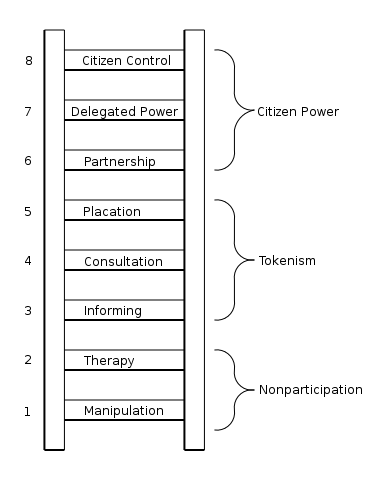 By the mid-70s, I’d already invested nearly a decade in the struggle against Dr. King’s “Triple Evils” – racism, militarism and poverty. Throughout high school, I tutored young children failed by the public schools in the project’s neighborhood center. Then, just a month into my first semester of college, the movement called and I left to do anti-draft outreach in the ‘hood.
At the time, grassroots efforts against poverty were ostensibly driven by the notion that the poor were entitled to “maximum feasible participation” in programs meant to benefit them.
I was a confirmed believer, but that lofty ideal was rarely realized. Over time, I grew increasingly frustrated as “participation” devolved into empty tokenism (superficial placation or perfunctory consultation) and Lyndon Johnson’s rhetorical war on poverty morphed into the GOP’s protracted war on the poor and working class.
I was first exposed to theories of social and experiential learning and organizational development while working for the Virginia State Economic Opportunity Office, the state-level liaison for anti-poverty initiatives in Virginia. I had the opportunity to apply and test these new learnings in a range of community venues to address issues of power, agency and voice.
I focused on two areas: 1) team-building and strategic planning to establish a multidisciplinary task force on child care and development, and 2) troubleshooting political tensions between local elected officials (the all-white old guard) and a community action agency (mostly-black led grassroots challengers). I learned that much of what I was doing with community-based organizations was being called “popular education.” I brought those learnings to subsequent work as an organizer for various grassroots initiatives, progressive campaigns, and progressive coalition efforts.
Currently, my focus is in the arena of public education, where issues of voice, agency and alliances pit well-connected insiders (politicians, bureaucrats, corporate interests, university or think tank wonks, venture philanthropists, education entrepreneurs, and corporate media) against those with the most at stake in the ed-reform process (students, parents, teachers, and communities).
Check out the first post on my blog, Cimarrón, for more. It pretty much sums up who I am, where I came from and how I roll.
Why is popular education important for movement building? What sets it apart from more conventional educational models?
Barry Checkoway's literature on social change distinguishes six distinct categories of community change strategies: 1) issue-focused mass mobilizations; 2) confrontational social action; 3) government-sponsored citizen participation; 4) expert advocacy; 5) local development (self-help); and 6) popular education.
 The first five approaches emphasize securing either a “seat at the table” or a “piece of the action.” They focus on the immediate need, rather than sustainability, and primarily seek to alter the existing distribution of resources and benefits on behalf of the traditionally locked out or marginalized, rather than transforming the longstanding arrangements of wealth, status and influence, which create those conditions in the first place.
Instead of building the capacity of community members to solve their own problems, these strategies focus narrowly on enlisting outside forces and resources to “fix” the community. They fail to acknowledge that a "seat at the table" doesn't always guaruntee the ability to influence, or even know, what's happening under the table. Likewise, the size of one's piece of the pie is ultimately determined by those serving the pie.
In contrast, popular education promotes a kind of ‘transformative populism’ by which socially- and politically-marginalized peoples are encouraged and enabled to pursue the power to influence the decisions affecting their lives and livelihoods.
As a strategic response, pop-ed is informed by a critique of actual social, political and economic relationships. Additionally, the popular education strategy can support other change strategies by providing an analytical platform enabling community members to choose the most appropriate strategies for particular situations.
Click here to continue to part 2 of the interview with popular educator, Ty dePass.
Interview with a Popular Educator: Ty dePass (2 of 2)
Ty, would you share with us a specific instance in which you witnessed the effectiveness of popular education?
The D7 RoundTable was a community-based organization focused on the struggles against racism, violence, and poverty in Greater Roxbury – Boston’s poorest, brownest, most culturally-diverse, and politically-marginalized neighborhood. For eight years, from 2000 to 2008, D7 convened a monthly grassroots public policy forum, bringing residents of Roxbury and Boston's other progressive communities together to examine, debate, and exchange opinions on a host of critical issues and public institutions.
 In the spring of 2001, Boston’s public schools were being criticized for an evident “achievement gap,” as reflected in the scores of mandatory standardized tests. D7 dedicated one of its regular monthly forums to exploring the issue – specifically, the factors contributing to the “gap” in student test performance.
The nearly one hundred community members who attended the forum were seated at tables of with 8 to 9 of their neighbors. On each table was an information packet providing a detailed profile of a selected area school district or local high school.
The popular education exercise was divided into three rounds. In round one, participants were tasked with becoming “experts” on their data packets and answer three questions: 1) What do you see in the data? 2) What, if anything, stands out to you? and 3) How might this explain the “achievement gap”?
In round two, the tables were reconfigured to mix the research teams. This is called the “jigsaw method." The new teams were then tasked to compare and contrast their findings on the districts or schools examined, based on a new set of questions: 1) What similarities and differences stand out to you? 2) Which items appear most relevant to student achievement? and 3) What is the problem and where should Boston’s reform efforts begin?
The final round was devoted to a full-group discussion focused on describing the problem (test score disparities), its contributing factors (student body by race, income, language proficiency, student suspension days, curriculum access), and specific recommendations for change. participants displayed an impressive grasp of the data and its implications, often making surprising connections and inferences. Many participants shared with us how much they enjoyed the exercise, some even expressing their surprise over the how much they now understood doing policy research.
The only downside was that the exercise wasn't connected to an actual organizing initiative for school reform. Nevertheless, after ten years, a number of individuals who participated in the event and are now involved in local reform efforts tell me they remember the exercise clearly and use similar models in their own work.
One of the principles of popular education is that education must be a reciprocal process between facilitators and participants. It is an acknowledgement that no individual has all the answers, and that our unique lived experiences allow each of us to act as both sudents and teachers. What's one of the most important things you have learned in your work with other groups?
 I start from the general assumption that most of what we think we know, just ain’t so. By this, I mean that we must be alert to testing our assumptions and risking exposure to new ideas. This is not the same as blindly accepting “expert knowledge," because we need to test that as well. But it does appreciate that the most useful knowledge is grounded in real world experience. Knowledge is best constructed as a collective effort – it is never fixed and it must be subject to challenge once it fails to explain new experiences.
How can others around the country get involved in popular education for social & economic justice?
To say, “get involved,” in popular education is an accurate formulation. Pop-ed is a medium for constructing people’s knowledge, a strategy for raising consciousness and informing appropriate action. It’s more a means to an end than an end in itself.
There are already a number of national organizations and networks that folks can get involved with that have a history of using pop-ed techniques as a medium for progressive organizing.
Among them are the Right to the City coalition, the Applied Research Center, the Highlander Research and Education Center, the People’s Institute for Survival & Beyond, Project South and various local expressions of people’s theater, a.k.a., “Theater of the Oppressed."
What are your short- and long-term hopes for the progressive movement both within the U.S. and in the global community?
In the short-term, I’m hoping to see the emergence of the broad, multi-racial and united front against war, racism and poverty envisioned by Dr. King more than 40 years ago. This is a major piece of unfinished business for progressives. In the long-term, I’m just hoping to be around long enough to finally enjoy the fruits of that movement.
Click here to go back to part 1 of the interview with popular educator, Ty dePass.
Crossing the Corporate Moat – RW Fights Unfair Foreclosures
By Responsible Wealth Intern, Adriana Hernandez
Since last fall, Responsible Wealth (RW) members and our allies have been working on a shareholder resolution and strategies to shed light on how banks and mortgage servicing institutions are handling foreclosures.
 Through this work, RW developed partnerships with, among others, New York’s Neighborhood Economic Development Advocacy Project (NEDAP) and the PICO National Network. Together, we drafted resolutions on foreclosure mitigation practices, and consolidated our resolutions into one that targeted the use of robo-signing throughout the foreclosure process.
Thanks to the support of RW members, this resolution was filed at Bank of America, JP Morgan Chase and Wells Fargo in November. Unfortunately, our resolution was beat out by less than 48 hours by similar resolutions filed by the AFL-CIO and the Comptroller of the City of New York. As a result, our resolutions were not on the ballots (as those that preceded were substantially similar), but that didn’t mean our fight was over.
When the annual meetings rolled around, RW members were enlisted to provide access to twenty-six people for the meetings at JP Morgan Chase and Wells Fargo.
Despite fortress-like security at the JP Morgan Chase meeting, our allies were able to traverse the castle moat (literally!) to join the meeting. The proxies provided by RW members allowed advocates a platform to directly address CEO Jamie Dimon, asking him if he would stop foreclosures. They also demanded to know what Dimon planned to do to help those whose homes had been wrongly foreclosed—including families with a parent serving in the military overseas.
Ultimately, though not to our surprise, the resolution with JP Morgan Chase did not pass. Although, Dimon's response, "Maybe," was quoted in several news accounts of the meeting.
At the Wells Fargo shareholder meeting, our allies brought with them a group of protesters so large that their chants from the ground floor were delivered loud and clear to the enclosed meeting room on the 15th floor!
 In the meeting, our members and allies called on Wells Fargo CEO John Stumpf to impose a moratorium on foreclosures until more comprehensive and ethical foreclosure policies could be developed to provide families the opportunity to save their homes.
For several minutes, our allies' voices dominated the meeting. As expected, Stumpf would not relent, and, as our allies persisted, Wells Fargo resorted to having some arrested.
While neither resolution made it through the corporate gauntlet, they were effective in raising both shareholders' and the media's awareness of the questionable foreclosure practices of these financial giants. And it is on that enhanced awareness that we can build stronger cross-class relationships and a louder collective voice for corporate accountability.