
Senate Votes Down Permanent End to the Estate Tax

"[...] Partisan wrangling last year resulted in the estate tax dropping to zero in 2010, costing the government billions in revenue. Democrats hope to reinstate the tax for next year, exempting the first $3.5 million of a person or family’s estate and taxing the rest at up to 45 percent. That makes it the country’s most progressive tax, applying to less than one percent of estates.
An alternative proposal, by Sens. Blanche Lincoln (D-Ark.) and Jon Kyl (R-Ariz.), calls for an exemption of $5 million and a top rate of 35 percent. If the Senate does not act, the tax bounces back to 2001 levels, with an exemption of $1 million and a top rate of 55 percent. [...]
But today, some very, very wealthy folks publicly lobbied for the estate tax — essentially saying, “Take my money, please.” They argue that the tax encourages charitable giving and planning among wealthy families — and is good for the country. Warren Buffett and Bill Gates have previously called for a high estate tax, and on fellow billionaires to give wealth away. And today, so did Bob Rubin, the former Treasury Secretary, a Disney heiress and a number of others. [...]"
Read the full column by Annie Lowrey on WashingtonIndependent.com
Some super rich say: Tax my estate, please

"Some high-profile, high net-worth folks on Wednesday called on Congress to impose a 'strong' estate tax going forward.
'Our country is on an unsustainable fiscal path. [Revenue from an estate tax can] fund deficit reduction, additional public investment, or added assistance to those affected by the economic crisis,' said Robert Rubin, who served as Treasury secretary during the Clinton administration and more recently as chairman of Citigroup.
Moreover, Rubin added, 'our nation has always held itself out as a meritocracy and a land of opportunity, and an estate tax helps avoid accumulation of inherited economic and political power that is antithetical to this historical vision of our society.'
Rubin was joined by former hedge fund manager Julian Robertson, Walt Disney's grand-niece Abigail Disney and AFL-CIO president Richard Trumka on a call organized by liberal group United for a Fair Economy. [...]
What next for the estate tax: The debate is made more complex by growing concern over the country's fiscal situation given the economic slowdown and the approach of unsustainable spending by the end of the decade.
The individuals who spoke out on Wednesday are advocating for an estate tax that is equal to or stronger than what was in place in 2009. [...]
Those who support an estate tax say, among other things, that it bolsters charitable giving, since making bequests is a tax-deductible event and reduces the size of one's taxable estate.
Warren Buffett and Bill Gates have called on billionaires to become uber-philanthropists by giving away at least half of their net worth to charity. Doing so would substantially reduce the taxes their heirs would owe and therefore greatly reduce Uncle Sam's take.
'It's a wonderful idea. But the nonprofit sector can't do what the government does,' said Disney, who runs the Daphne Foundation. She noted that directing money to a given cause is worthy but no substitute for putting money into a communal pot that the government can use to perform vital functions that no charity does -- like provide infrastructure and defense.
'What you do around estate taxes should not be to avoid paying your fair share,' she said."
Read the full column by Jeanne Sahadi on CNNMoney.com
Julian Robertson and Robert Rubin DON'T Want to Pass Tax-free Fortune to Heirs

"Right now, millionaires and billionaires who die in 2010 can pass on their fortunes to heirs without any estate tax.
So, thanks to the expiration of 2001 Bush tax cuts and the year of Congress not doing anything about it, many somewhat cruel heirs have, maybe, a reason to hope their parents die this year.
Two guys that are now saying they want the estate tax reinstated ASAP, hopefully before August when Congress recesses, are Julian Robertson and Robert Rubin. [...]"
Read the full column by Courtney Comstock on BusinessInsider.com
Bring Back the Estate Tax, Some Rich Americans Say

"What do Disney heir Abigail Disney, hedge-fund billionaire Julian Robertson and former Treasury secretary Robert Rubin have in common? They want rich people to pay estate taxes and they say they're willing to pay those taxes themselves.
On Wednesday, Disney, Robertson, Rubin and Richard Trumka, president of the AFL-CIO, joined with the advocacy group United for a Fair Economy to call on Congress to reinstate the estate tax before lawmakers' August recess.
"My life of great comfort was made possible in spite of the estate tax, and my grandfather would be the first person to tell you he was able to amass his fortune not in spite of but because of the American system," including that tax, Abigail Disney, grandniece of Walt Disney and granddaughter of Roy Disney, said in a conference call with reporters.
For his part, Julian Robertson, on Forbes' list of the 400 richest Americans in 2009, whose firm Tiger Management was one of the first hedge funds in the 1980s, said the estate tax is a key tool for lowering the government deficit.
"You don't get out of a credit crisis by borrowing more money. You get out of a credit crisis by putting your house in order, and in America's case by bringing its budget deficit down," Robertson said on the call. [...]"
Read the full article by Andrea Coombes on MarketWatch.com
Rubin, Robertson, Disney Urge Congress to Resurrect Estate Tax That Lapsed

"Former Treasury Secretary Robert Rubin, Tiger Management LLC Founder Julian Robertson and an heir of Walt Disney urged Congress to reinstate a tax on multimillion-dollar estates, possibly retroactively.
The three were joined by AFL-CIO President Richard Trumka today to support efforts by a Boston-based advocacy group, United for a Fair Economy, pressing lawmakers to act before Congress adjourns for a month-long recess in August.
The deaths of New York Yankees owner George Steinbrenner and at least three other billionaires this year has focused attention on the absence of the levy, which lapsed Jan. 1. Had they died in 2009, they would have paid as much as 45 percent on much of their estate, depending on how their wills were structured.
“We should restore the estate tax in its entirety, and restore it now,” Rubin, who was Treasury secretary under President Bill Clinton, said on a conference call with reporters. He said making the tax retroactive to cover all of 2010 “should be very seriously considered.”
In 2001, Congress passed legislation phasing out the estate tax over the following decade and eliminating it for 2010. Unless Congress acts, the levy is scheduled to return in 2011, with a top 55 percent rate that would apply to amounts of taxable estates that exceed $1 million. [...]"
Read the full article by Ryan J. Donmoyer on Bloomberg.com.
Rubin, Robertson Want U.S. Estate Tax Reinstated

"Former U.S. Treasury Secretary Robert Rubin and Tiger Management founder Julian Robertson have joined a growing chorus calling for the U.S. estate tax, which expired last year, to be reinstated by Congress before its August recess.
The recent death of New York Yankees boss George Steinbrenner helped shine a spotlight on an unprecedented situation: millionaires and billionaires who die in 2010 can pass on their fortunes to heirs without any estate tax, thanks to the expiration of 2001 Bush tax cuts followed by a year of Congressional inaction.
Now a group that includes formerly Goldman Sachs co-head Rubin, hedge fund pioneer Robertson and Walt Disney heir Abigail Disney are calling on Congress to reinstate the estate tax before the August recess. These three, along with AFL-CIO President Richard Trumka will speak at a Wednesday press conference.
The estate tax, which was reduced in 2001 by the Bush Administration, expired at the end of last year. It has not yet been replaced amid debate over how high the bar should be set for exemption and how steep the rate should be. [...]"
Read the full article by Joseph A. Giannone on Reuters.com
Ex-Treasury Secretary Rubin Calls For Prompt Return Of Estate Tax

"Former Treasury Secretary Robert Rubin called on Congress to immediately reinstate the estate tax, and said lawmakers should consider re-imposing the tax on the heirs of wealthy individuals who escaped it by dying this year.
Rubin, who spoke during a conference call sponsored by liberal group United For a Fair Economy, said that retroactive tax increases are "ordinarily considered not a good thing." But that's because in many cases taxpayers will argue that they relied on the current tax code--a more difficult case to make when it comes to the timing of one's death, Rubin said.
Therefore, making the tax retroactive to Jan. 1 "should be very seriously considered," Rubin said.
The estate tax was repealed for one year beginning Jan. 1. Unless Congress intervenes, it will return in 2011 to tax estate wealth in excess of $1 million at a 55% rate. [...]"
Read the full article by Martin Vaughan of Dow Jones Newswires on Nasdaq.com.
Billionaires Battle On Estate Tax

"Hedge fund billionaire Julian Robertson joined former Treasury Secretary Robert Rubin and Disney heiress Abigail Disney in a teleconference call today to urge Congress to restore a hefty estate tax before it goes home for recess in August.
'America is in a situation where it needs every dollar it can raise and this, the inheritance tax, is the fairest way to raise it,' said Robertson, who described inheritors as 'the least deserving recipients of wealth.' Rubin, who made his money as a Goldman Sachs partner and executive, described the passing of untaxed wealth as 'antithetical' to the 'dynamism' of the American economy.
The conference call was sponsored by United for A Fair Economy, whose Responsible Wealth project has recruited more than 2,000 high-net-worth folks, including George Soros; William Gates Sr., the father of Microsoft founder William Gates III and Vanguard Group found Jack Bogle to sign a "Call to Preserve the Estate Tax. [...]"
Read the full column by Ashlea Ebeling and Janet Novak on Forbes.com
Rubin, Trumka find common ground on estate tax

"The unlikely duo of AFL-CIO President Richard Trumka and former Treasury
secretary Robert Rubin told reporters on a conference call Wednesday
that the estate tax — which has lapsed since the beginning of the year —
should be put back in place before the August congressional break.
When
asked why they both support reinstating the tax despite past
differences, Trumka joked, “The reason we agree is Bob has finally seen
the light.”
Rubin and Trumka have often clashed, with labor
leaders warning Democrats to distance themselves from the free-trade
policies advocated by Rubin and other Democrats with ties to Wall
Street. [...]
Both Rubin and Trumka said restoring the tax would be 'sound policy.' [...]"
Read the full post by Kevin Bogardus on The Hill's "On the Money" blog
Organizing for Success
Four months ago, 300 plus workers from the Shaw’s distribution center in Methuen, MA went on strike. This month, they're celebrating a victory.
The strike was born when workers voted in opposition to a contract that would cut their healthcare benefits. Shaw’s refusal to absorb the cost of an increase in premiums would cause workers a loss of $28 per week, which accumulates to $1,456 annually. Shaw's management stubbornly moved forward by hiring replacement workers and terminating healthcare for the striking workers.
In late May, the workers’ union, United Food and Commercial Workers Union, Local 791, organized a 60-mile, 5-day “March for Justice” beginning in Methuen and ending in Boston. Public officials, including Sen. John Kerry and Rep. Michael Capuano, urged Shaw's/Supervalu president and CEO Craig Herkert to reach a settlement.
The workers approved a new four-year contract–including wage increases and more affordable healthcare–on July 8th, ending the bitter strike. The temporary workers will be phased out gradually, allowing for the union workers to resume their positions.
A joint press release by UFCW and Shaw's stated, “The four-year contract continues Shaw’s long-standing history of providing good wages, comprehensive and affordable health care and a generous retirement plan,” although the original contract didn't exactly live up to this commitment. Many continue to feel that the ratified contract isn't enough–especially considering the months of lost pay–but the victory is about more than the final terms.
This resolution demonstrates the perseverance of the workers and the commitment of the union and communities to stand behind them. Supervalu was greedy and determined to break the union with intimidation, but the workers were unbending and rallied an enormous amount of support, ultimately forcing the company to renegotiate the contract.
The victory was made possible, in part, by the Commonwealth of Massachusetts, which granted unemployment benefits that were vital to the workers’ ability to sustain the strike. Additionally, a strike fund, for which over $180,000 was raised, played a key role in giving the Shaw's workers the financial wherewithal and morale to continue the strike.
Anthony Zuba, leader of the Interfaith Committee for Worker Justice, said healthcare should never be used as an “economic weapon,” and this 4-month battle is a lesson in why. The workers, union, advocacy groups and communities stood bravely and found their own weapon in a collective voice for workers' rights.
Estate Tax Myths Repackaged as Income Tax Myths
Conservative bluster about the Bush Tax Cuts for the wealthy reminds Kevin Drum of conservative bluster about the estate tax. He harkens back to the heat of the estate tax debate under President Bush.
Back in the day, one of the key Republican arguments against the estate tax was that it forced hardworking, salt-of-the-earth children of small farmers to sell the family plot in order to pay their taxes after dad died. It was a sad story, but with one problem: no one could find even a single small farmer who had been forced to liquidate in order to satisfy Uncle Sam's voracious maw. Even the American Farm Bureau Federation was eventually forced to admit that it couldn't come up with a single example, and a few years later the Congressional Budget Office estimated that under the now-current exemption level, only a tiny handful of small farms were likely to owe any estate tax to begin with — and of those, only about a dozen lacked the assets to pay their taxes. And even those dozen had 14 years to pay the bill as long as the kids kept running the farm. In other words, the story was a fraud from beginning to end.
The same argument is still being made by the anti-tax lobby to smear the estate tax, and it is still nonsense. That's why we're still putting out the facts about family farms and the estate tax. The new variation to the nonsense is the claim that small business owners will bear the brunt of ending the Bush income tax cuts on the top tax bracket. Prompted by Senator Chuck Grassley's (R-IA) public dare, Drum takes that argument apart in four quick steps.
Step 1: The Brookings Tax Policy Center estimates that only 1.9% of small businesses are in the two top brackets that would be affected. That's a little better than the dozen small farms affected by the estate tax, but not by much.
Step 2: About half of that 1.9% aren't really small business owners at all. They're high-income investors who get part of their income from investments in small businesses. So we're down to about 1% of small businesses that would be affected.
Step 3: The top brackets are just that: brackets. When the top rate goes up, it doesn't affect your entire income, just the portion in the top bracket. So if the top rate goes back up from 35% to 39.6%, it only affects the portion of income above approximately $400,000. A small business owner making $500,000 would see an increase of about $5,000. This is a fairly modest amount for someone making a half million dollars, and anything higher than that is hardly a "small" business to begin with. And the marginal effect is even smaller for the second highest bracket.
Step 4: The Office of Management and Budget estimates that the 10-year cost of these upper-income tax cuts is $678 billion, the vast majority of which hits wealthy individuals, not small businesses no matter how you define them. That's a fair chunk of change for anyone concerned about the deficit.
So that's the case. Letting Bush's tax cuts for the rich expire affects only a tiny number of small businesses; it doesn't affect them very much; and it generates revenues of $678 billion. If the only thing you care about is keeping taxes low for rich people, you won't be convinced. For the rest of us, it's a no-brainer. [emphasis added]
The $678 billion dollar figure does not include additional tens of billions of dollars that will either be generated in revenue or added to the deficit based on what we decide to do with the estate tax this year. Remember, the estate tax was gutted by the same Bush tax cuts, and like the rest of the Bush tax cuts, the estate tax cuts are set to expire at the end of this year too.
There's some real big choices to make this year. Should we hand out billions of dollars in tax breaks to the richest of the rich, or should we generate some much needed revenue? Should we keep a few dollars in the pockets of millionaires and billionaires, or should we generate start to turn around the trend of growing economic inequality?
Congress Passes Financial Reform
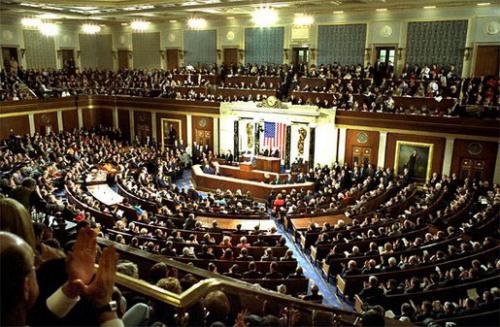 The Financial Reform bill has been passed by both houses of Congress and now awaits President Obama's signature. When the President signs his name, the new law will be the biggest improvement to regulation of the financial industry in generations. It's a big change with a lot to it, but reigning in Wall Street and the excesses of finance will not be accomplished with one new law alone. But for now, it's time to celebrate what truly is an historic victory.
Of the many good things in the final package, the new consumer protections may be the sweetest. The new Consumer Financial Protection Bureau made it through in a reasonably strong form, and has a chance to truly protect consumers from many of the abuses that plumped up bank profits and bonuses at the expense of the public. Members of UFE and our Responsible Wealth project deserve to be particularly proud for standing up for the consumer financial protection in this bill.
Chris Sturr at Dollars and Sense (a magazine you should subscribe to if you don't already) runs down some more details. He links to an excellent explanation of what's in the bill, what got cut out, and what never even had a chance.
Some more reactions:
- Shahien Nasiripour (who has also become a must read) teams with Ryan Grim at the Huffington Post for a wrap up on passage of financial reform.
- Ezra Klein highlights some of the positives.
- Simon Johnson is hard to please, but he sees some encouraging similarities to past regulatory efforts.
- And Kevin Drum made a good the case for the bill when it's passage was still, at least somewhat, in doubt.
Wealthy Cashing in Huge, Workers' Salaries Shrinking

"Times are tough for workers in the U.S. where a recession has a stranglehold on much of the economy, but life is perfectly rosy for those at the top.
The riches of the wealthiest North Americans grew by double digits in 2009, primarily from interest their money earned when it was invested in the stock market and elsewhere, according to a report by the Boston Consulting Group.
Millionaires in the U.S. and Canada saw their wealth increase 15 percent in 2009, to a total of 4.6 trillion dollars, the report found.
Worldwide, 11 million - or less than 1 percent of all households - were millionaires in 2009. They owned about 38 percent of the world's wealth or 111 trillion dollars, up from about 36 percent in 2008, according to Boston Consulting Group.
About 4.7 million millionaires live in the U.S., four percent of the population and more than anywhere else in the world. Japan, China, Britain and Germany followed the U.S. in the number of millionaires.
Their fortune is a stark contrast to the lives of more than 15 million people in the U.S. who are unemployed and searching for work, and the eight million more who are just getting by with a part-time job...More than two million more people were working prior to the recession but have now dropped out of the labour force. [...]
The recession isn't hitting those at the top as it has workers. In fact, many wealthy people benefited from the stock market's ups and downs, said Mike Lapham, director of the Responsible Wealth Project at United for a Fair Economy, an NGO in Boston.
'Folks at the top have a cushion, a disposable income to fall back on. Maybe their portfolios took a hit but they didn't lose their jobs and their homes. If they had losses, they can deduct them from their taxes,' Lapham told IPS. [...]"
Read the full column by Adrianne Appel on AlterNet.org (via Inter Press Service)
Companion to Sanders Estate Tax Proposal Introduced in House
Representative Linda Sanchez (D-CA) introduced a new estate tax proposal in the House of Representatives. The specifics are very similar to the Responsible Estate Tax Act (S.3533) introduced in the Senate in late June.
It is a good bill. Representative Jim McDermott's Sensible Estate Tax Act (HR 2023) is still the best proposal in the House. It stays closest to the AFET guidelines for good estate tax reform. However, the release of matching proposals in the House and Senate from Sanchez and Sanders, looks like a sign that progressive lawmakers are serious about fighting for a strong estate tax.
Congress needs to get serious about taxes. With the Bush tax cuts expiring and conservatives returning to their nonsensical rhetoric, the fight for progressive taxation is on.
The good news is that the American public strongly favors higher taxes on the rich, poll afterpoll after poll (pdf, page 16) backs up that fact. The estate tax, of course, is paid exclusively by millionaires, which is exactly the kind of tax the public wants. And, we're rallying more support for our nation's most progressive tax.
Stay tuned for more news coming out of our press conference on July 21st.
A Top Republican's Ingenious Plan to Shrink Government
Good stuff from Sarabeth Guthberg at 1115.org (via Steve Benen) taking apart Senator Kyl (R-AZ) for his most recent bit of idiocy about taxes. The second ranking Republican in the Senate told the world that he believes there is no reason to offset the cost of tax cuts. His comments drew a lot of attention, and so he tried to explain himself. Sarabeth goes to town on his clarification.
"First of all, o confused eminent personage of the Republican persuasion, the question wasn’t how to offset increased spending, the question was how to offset reduced tax collections.
Secondly, increased spending gets offset by reduced savings? If the government spends more and saves less, that’s a deficit-neutral plan? This entirely backward “reasoning” explains a hell of a bloody lot, doesn’t it, about why the deficit and the national debt got to where it is?
Thirdly, even if the master plan is to shrink government — in fact, especially if the master plan is to shrink government — the budget effect of a tax cut has to be offset. Kyl doesn’t even seem to realize that the deficit-shrinking tool kit includes spending cuts. Or that, if you want to shrink the government, it’s not enough to cut taxes, you have to bloody well cut spending too. Then, and only then, does the government shrink. And — this will probably come as a very rude shock to the guy, so as an act of Christian charity, we should make sure that Jon Kyl is sitting down when this is broken to him — the spending cut offsets the tax cut, to make it deficit-neutral."
Well said.
Of course, this is nothing new for Kyl who routinely sponsors horrible estate tax legislation and just a few months back tried hanging the unemployed out to dry to get his way. But the problem goes deeper than Kyl. Ezra Klein gets sad by paying attention to Mitch McConnel (R-KY) and finding that the problem is endemic to Republican leadership in the Senate.
For the record, that's the two highest ranking Senate Republicans (and in McConnel's words, "the view of virtually every Republican") denying the existence of facts about taxes.
No Tears for George Steinbrenner

Photo credit: Hazboy
Long before I moved to the Boston area in 1977 I had no love for the NY Yankees. Despite the fact that I grew up just a few blocks from Yankee Stadium, my family divided it’s loyalties between the Brooklyn Dodgers — the first team to break baseball’s color barrier — and the Giants (we would walk to the Polo Grounds to watch Willie Mays’ show off his amazing talents. To our working class sensibilities, the Yankees represented the ruling class of baseball, dominating the sport with the largest team payroll year after year, and displaying arrogance both on and off the diamond.
George Steinbrenner, who inherited his wealth from his father’s shipbuilding company and bought the team from CBS in the early 1970s with money from the family business, raised the level of pin-stripe hubris to new heights. In his first 17 seasons as owner, Steinbrenner hired and fired 17 managers; skipper Billy Martin was fired five times! His temper tantrums were legendary and his willingness to doggedly pursue free agents — the Kansas City Athletics were jokingly referred to as the Yankees’ farm team — ensured a steady stream of stars. Off the field, George’s antics included illegal contributions to Richard Nixon’s presidential campaign. Apparently, Steinbrenner had an affinity for employing seedy characters to bring down one’s enemies: he once hired gambler Howie Spiro to find dirt on on Dave Winfield, his own player, during contract negotiations.
While the Wall Street Journal eulogized Steinbrenner, praising his success in turning the Yankees “into a financial powerhouse,” they declined to mention that the wealthiest team in baseball received $362 million from New York City to build the lavish new stadium (New York State Assemblyman Richard L. Brodsky, D-Westchester, said the taxpayers' tab for Yankee Stadium eventually will total $4 billion, including potential property tax revenue over 40 years given up in the deal). The promised benefits to the neighborhood that, due to the construction, lost their ball fields and parks — where I played as a kid — have still not been replaced as promised.
And, oh yes, George Steinbrenner died with an estate worth about $1.3 billion, not a penny of which will return to public coffers through an estate tax. Due to the tax cut package George Bush signed into law in 2001, the Estate Tax was phased out step-by-step until January 1, 2010 when it ceased to exist all together. George is the fourth billionaire in the US to die so far this year leaving all their vast wealth to their heirs and designees alone.
Fortunately, the tax cut law has a sunset provision which means that on January 1, 2011, the estate tax will be restored to its 2001 level. Of course, the folks who think the Great Recession is no reason not to push through even more tax cuts for the wealthy are fighting the sunset tooth and nail. So if like me, you think George born-with-a-silver-spoon-in-his-mouth Steinbrenner will not appear on your list of the top 10 human beings who passed in 2010, you might consider contacting your Senators and Representatives and telling them to restore a responsible estate tax in “honor” of the Yankee capitalist.
Massachusetts Immigrant Rights Groups Fight to Win
After a 19-day protest, the Student Immigrant Movement (SIM) and allied organizations celebrated a victory in their campaign, Mass Hope 2010, for the Massachusetts legislature to overturn a budget amendment laden with anti-immigrant language.
For those 19 days, SIM members staged a 24/7 vigil in front of the State House, risking arrest by local law enforcement, as a stand in solidarity with immigrants, both documented and undocumented, in Massachusetts.
 SIM initiated Mass Hope in late May when the state legislature's conference committee released its budget proposal for the new fiscal year, which was laden with provisions that would have been an affront to the rights of immigrants and children of immigrants with regard to employment, housing, education and public services.
The anti-immigrant legislation, amendment 172.1, was not only a threat to immigrants' civil liberties, but would have also been costly for taxpayers and highly inconvenient for a state government that's already stretched thin by the ongoing recession.
Amendment 172.1 would have exemplified government at its worst. Its wasteful and punitive measures were neglectful of its impacts on the families of undocumented immigrants, and Massachusetts' immigrant communities as a whole. And, it would have done absolutely nothing to address the root causes of unlawful migration to the US.
SIM's mobilization succeeded in getting the conference committee to take their proposal back to the drawing board. The outcome was, in large part, a win for immigrant rights. While most of the proposed new restrictions and regulations were struck down, the final budget proposal contained provisions that codified existing practices and regulations as law.
The Massachusetts Immigrant and Refugee Coalition (MIRA) expressed mixed feelings about the final budget. In the process of drafting their final budget proposal, the conference committee eliminated a program that has been providing state-subsidized healthcare for nearly 30,000 documented immigrants, raising concerns for the physical and financial well being of thousands of men, women and children. Another concern MIRA has conveyed is the closed-door message the immigrant-related codifications send to future immigrants to Massachusetts, which has come to be known as one of the most immigrant-friendly states in the US.
The budget is now headed to the Governor's desk for review. Although most involved in Mass Hope are content with the conference committee's decisions, MIRA still cautions Gov. Deval Patrick to carefully consider the implications of the immigrant-related provisions they've deemed as problematic.
The vigil has officially ended, but SIM and other activists will keep up the pressure on their state legislators to defend and expand the basic rights of immigrants in Massachusetts. UFE is proud to have participated in Mass Hope. UFE staffers participated in the vigil, in rallies, provided support, resources and a space of community for the campaign planners, protesters and others involved.
Live Blogging: Talking Taxes
How do we make the case for government, the economy, and federal aid? Today, during day two of the National Coordinating Conference for the Campaign for Federal Aid to Communities, we'll hear from Patrick Bresette from Demos about how to talk taxes to generate support.
<a href="http://www.coveritlive.com/mobile.php/option=com_mobile/task=viewaltcast/altcast_code=24c275e8f2" mce_href="http://www.coveritlive.com/mobile.php/option=com_mobile/task=viewaltcast/altcast_code=24c275e8f2" >Live Blogging: Talking Taxes</a>
UFE's Shannon Moriarty is live-blogging from the National
Coordinating Conference for the Campaign for Federal Aid to Communities
on July 13th and 14th. Follow along as state organizers develop a
national strategy for demanding federal aid for jobs and essential
public goods and services.